
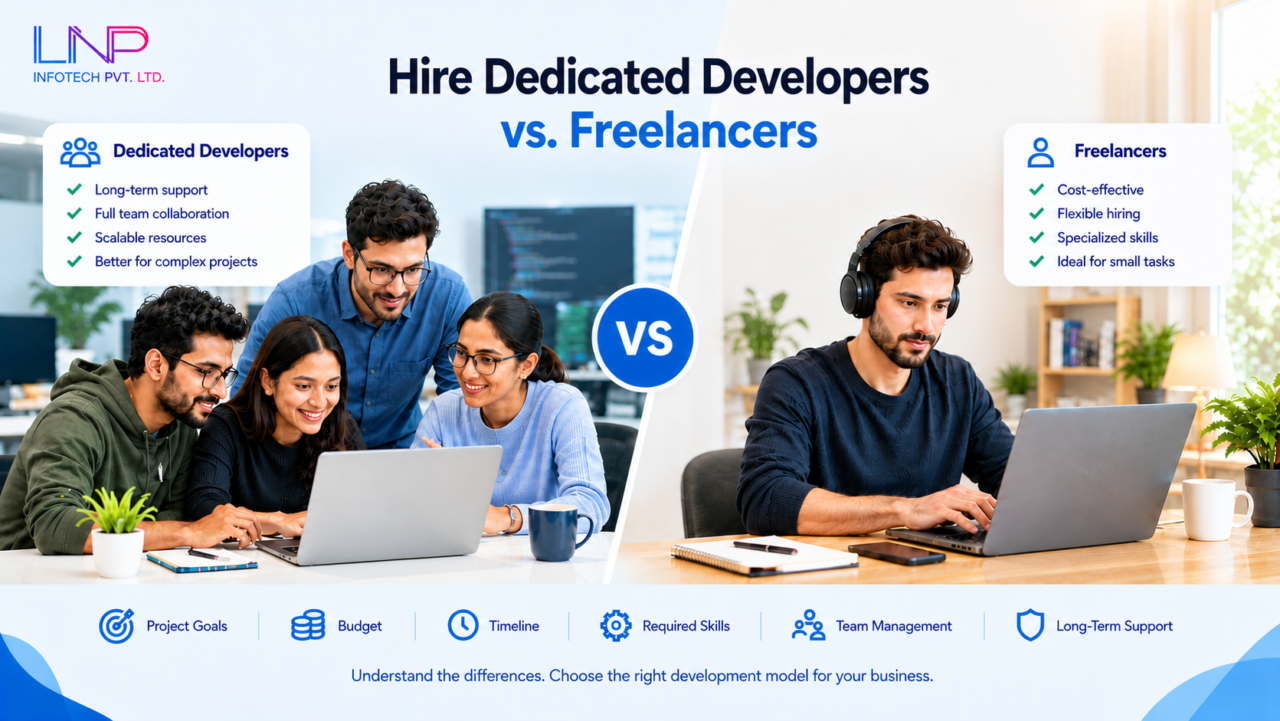
Short answer: Hire a freelancer for small, clearly defined, short-term work. Choose dedicated developers when the work is ongoing, business-critical, or needs several skills working together. Many teams end up using both.
Full disclosure: we offer dedicated development teams, so we have a point of view. This guide also covers when a freelancer is the better call, because picking the wrong model costs far more than any difference in hourly rates.
Key takeaways
- Freelancers fit small, well-defined, short-term work. Dedicated developers fit ongoing, multi-skill, business-critical products.
- The lowest rate is rarely the lowest total cost once management time, rework, delays, and handover are counted.
- Freelancer risks are mostly availability and dependence on one person. Dedicated-team risks are commitment and unclear priorities.
- Staff augmentation, fixed-scope projects, and in-house hiring are also options, and the right choice depends on who manages the work.
- Whichever you pick: own the repositories, put IP and exit terms in writing, and agree how communication works.
Why this decision matters more than it looks
Almost every software project hits the same fork early on: who is actually going to build this?
Hiring in-house is slow. Recruiting benchmarks put the time to fill a technology role at about 48 days (based on SHRM 2025 data), and engineering roles at around 62 days (Workable), and that is before the new hire has written a line of code.
So it’s no surprise that many teams look elsewhere. In a Remote survey of employers, 52% said they had increased their use of skilled freelancers over the past three years, and 46% pointed to difficulty filling roles as a reason.
The two most common alternatives are hiring freelancers directly or working with a development company that provides dedicated developers. On a quote they can look similar. Over six to twelve months they behave very differently. Staff augmentation and fixed-scope projects sit somewhere in between, and we compare all the models below.
What’s the difference, exactly?
- Freelancers are independent contractors you hire directly, usually through a marketplace or a referral. You agree on a scope and a rate (hourly or fixed price), and they work on your project alongside other clients.
- Dedicated developers are engineers employed by a development company and assigned to your product for an agreed period, typically full-time. They work as an extension of your team and follow your priorities, while the company handles hiring, payroll, equipment, and backup. You can see how we approach this on our dedicated team page.
Side-by-side comparison
| Comparison | Freelancer | Dedicated developers (via a company) |
|---|---|---|
| Best for | Short, well-defined tasks | Ongoing or evolving product work |
| Typical pricing | Hourly or fixed price per task | Monthly rate per developer or team |
| Time to start | Can be very fast, but quality varies widely | Often much faster than in-house hiring |
| Availability | Shared with other clients, depends on the individual | Agreed capacity, usually full-time on your work |
| Skills covered | One person, one skill set | Can combine frontend, backend, QA, DevOps, and design |
| Your management effort | High: you define tasks, review code, and chase progress | Lower: the vendor runs team operations, you still own priorities |
| Continuity | If they leave, the knowledge often leaves too | The vendor can replace or back up developers and manage handover (confirm this in writing) |
| Code standards and QA | Depends on the individual | Can be enforced through team-level code review, testing, and process |
| Security and compliance | Depends on the individual’s own setup, harder to audit | Company-level policies, NDAs, and access controls (verify before you sign) |
| Scaling up or down | Add more freelancers and coordinate them yourself | Add or remove developers within the same engagement |
Pros and cons at a glance
| Comparison | Pros | Cons |
|---|---|---|
| Freelancers | Low commitment, fast to start, strong for niche skills, pay only for the task | Shared attention, single point of failure, uneven standards, and you manage the work |
| Dedicated developers | Focused capacity, continuity, broader skill coverage, scales with the roadmap | Monthly commitment, needs clear priorities and a product owner, vendor quality varies |
It’s not only a two-way choice
Teams often compare freelancers with dedicated developers when a third option fits better. The models differ mainly in who manages the work and how long you commit.
| Model | Who manages day-to-day work | Typical commitment | Best for |
|---|---|---|---|
| Freelancer | You | Per task or per hour | Small, defined, short-term jobs |
| Staff augmentation (team extension) | You: external specialists join your team and follow your backlog | Usually monthly | Filling skill gaps in a team that already has strong management |
| Dedicated team | Shared: you set priorities, the provider coordinates delivery | Usually monthly, often with a minimum term | Ongoing product work that needs continuity and several skills |
| Fixed-scope project | The provider | Per project | Well-defined work with a clear end |
| In-house hire | You | Permanent employment | Core capabilities you want to own long term |
Providers use these labels differently, so confirm exactly who owns priorities, day-to-day management, and delivery before you sign.
When freelancers are the right call
A good freelancer is a real asset. They’re usually the better choice when:
- The task is small and clearly defined, such as a landing page, a bug fix, a plugin, or an integration with well-documented endpoints.
- You need a rare specialist for a short time, such as a security review, a performance audit, or a one-off design job.
- You’re validating an idea, and a prototype you may throw away is fine.
- You have a technical lead in-house who can scope the work, review the code, and own the architecture.
- The budget is tight and the cost of a missed deadline is low.
The trouble usually starts when a freelancer is asked to do a team’s job.
When dedicated developers are the better fit
Dedicated developers tend to win when:
- The work is ongoing. Your roadmap runs in quarters or years, not weeks.
- You need several skills at once. Frontend, backend, testing, and DevOps all matter. You can hire for specific skills, for example .NET developers, React developers, full-stack developers, QA engineers, or DevOps engineers.
- Continuity matters. Product knowledge needs to stay with a team, not with one person.
- You handle sensitive or regulated data. In areas like healthcare and financial services, you need NDAs, access controls, and a clear audit trail.
- You don’t have a technical manager to run the day-to-day work.
- You expect to scale. A growing product such as a multi-tenant SaaS platform rarely stays the same size for long.
Where projects go wrong (on both sides)
With freelancers
- Availability. Upwork’s research found that 82% of skilled freelancers reported more work opportunities than a year earlier, compared with 63% of full-time employees. That’s good news for freelancers. It also suggests the best ones are in demand and may be juggling several clients, so agree on expected hours up front.
- A single point of failure. If one person holds all the knowledge and moves on, you’re left with code nobody else understands.
- Inconsistent standards. Different freelancers on different tasks can mean different conventions, patchy tests, and little documentation. That’s one reason teams sometimes need legacy software modernization or help from clean architecture experts later on.
- Hidden management work. You become the project manager, whether you planned to or not.
With dedicated developers
- Higher commitment. Monthly engagements mean you pay for capacity even in quieter weeks, so you need a backlog that keeps people busy.
- You still need a product owner. A dedicated team builds what you prioritize. Unclear priorities produce a busy team and a disappointing product.
- Vendor quality varies. The model only works if the company is transparent and its engineers are strong. Check references.
- Time zones and communication. Agree on overlap hours and update rhythm early.
Communication deserves special attention in both models. PMI’s Pulse of the Profession research identified effective communication as the most crucial success factor in project management, and estimated that 56% of project spending is at risk when communication is poor (a 2013 report, but the lesson hasn’t aged). Whichever route you choose, ask how updates happen, who you’ll talk to, and what happens when something slips.
How to compare cost fairly
A freelancer’s hourly rate often looks lower than a dedicated developer’s monthly rate. But the rate isn’t the cost. Add up:
- Rate × hours, including the hours spent fixing and redoing work
- Your management time: briefing, reviewing, and chasing
- Delays, including the weeks lost finding a replacement if someone disappears
- Onboarding every time someone new picks up the code
- Risk, such as a security gap or a codebase only one person understands
For a small, clear task, a freelancer usually wins on total cost. For continuous work, a dedicated team often comes out ahead once management time and continuity are counted. Whichever you choose, ask for a quote that spells out what is and isn’t included.
How pricing usually works
- Hourly (time and materials): flexible, but the total moves with the hours, so it needs tracking.
- Fixed price: predictable for a well-defined scope, though changes usually mean change requests.
- Monthly per developer or team: a steady run rate for ongoing work, but you pay for capacity even when the backlog is thin.
That last point is the main cost risk of a dedicated team. If your work arrives in occasional bursts, idle capacity can erase the savings.
Real-world scenarios
| Situation | Better fit | Why |
|---|---|---|
| A founder needs a marketing site and a simple booking form in three weeks | Freelancer | Small, defined, short-term |
| An online store needs performance tuning before a seasonal sale | Freelancer | Focused, time-boxed specialist work |
| A SaaS startup is building a multi-tenant platform with a 12-month roadmap | Dedicated developers | Ongoing, multi-skill, continuity matters |
| A clinic software company is adding features that touch patient data | Dedicated developers | Compliance and access control matter |
| A company inherited a half-finished app built by several freelancers | Audit first, then a dedicated team | You need to know the code’s condition before building more |
| A team with a strong in-house lead needs two extra engineers for six months | Staff augmentation | You already manage the work and need capacity |
| A team needs a one-off security review | Freelancer or specialist | Short-term, specialist work |
| A product team needs a designer for two weeks plus ongoing engineering | Both | Freelancer for design, dedicated team for the core |
A simple decision checklist
Answer yes or no:
- Will the work last longer than about three months?
- Do you need more than one skill (for example backend, frontend, and QA)?
- Is the scope likely to change as you learn?
- Does the product handle sensitive or regulated data?
- Do you lack someone in-house to manage developers day to day?
- Would losing your developer mid-project seriously hurt the business?
Mostly yes: lean toward dedicated developers.
Mostly no: a freelancer is probably enough.
Questions to ask before you sign (either model)
- Who owns the code and IP? Make sure assignment of ownership is written into the contract.
- Where will the code live? Insist on repositories you own and control.
- Who reviews the code, and how is it tested?
- What happens if the developer becomes unavailable or leaves? How is knowledge handed over?
- How often will you get updates, through which channels, and during which overlap hours?
- Can you speak to past clients? You’ll find some of ours speaking about their experience in the video testimonials on our homepage.
- What are the notice period and exit terms?
- How are security, NDAs, and access handled?
Two more things to settle before work starts: who handles bug fixes and support after launch, and how access is removed and code handed over when the engagement ends. Also ask how changes in scope are estimated and approved.
Can you use both?
Yes, and plenty of teams do. A common pattern is a dedicated core team for the product, plus freelance specialists for short bursts of work like design or a security audit. Another is to start with a freelancer to prove an idea, then move to a dedicated team once the product has traction. If you plan to do that, build the handover in from day one: documentation, architecture notes, and repositories under your own account.
Not sure which model fits your project?
Tell us what you’re building, how long you expect it to run, and which skills you need, and we’ll give you an honest view, even if the answer is that a freelancer is enough. You can also see how we work on our development process page, or explore our custom software development services.
Frequently asked questions
Are freelancers cheaper than dedicated developers?
Often their rate is lower, but total cost depends on the scope, the rework, and how much of your time goes into managing the work. For small, well-defined tasks, freelancers are usually cheaper overall. For ongoing product work, the gap tends to narrow or reverse.
Is a dedicated developer the same as an in-house employee?
No. A dedicated developer is employed by the development company, not by you. They work on your product and follow your priorities, while the company handles HR, payroll, equipment, and replacements.
Can I start with a freelancer and switch to a dedicated team later?
Yes. It helps to keep your code in your own repositories and to document decisions as you go, so a new team can pick up quickly. If the existing code needs cleanup first, services like legacy software modernization can help.
What happens if a dedicated developer leaves the project?
This is one of the most important questions to ask any vendor. Ask how replacements are handled, how long a handover takes, and how knowledge is shared across the team so no single person is irreplaceable.
How do I protect my intellectual property?
Use a written agreement with IP assignment and an NDA, keep source code in repositories you own, and control access through your own accounts. This applies to freelancers and companies alike.
Who manages a dedicated development team?
It depends on the engagement, so agree it in writing. Usually you own priorities, approvals, and product decisions, while the provider coordinates the team’s day-to-day delivery. In a looser staff augmentation setup, you manage the developers directly. Either way, someone on your side needs to own the backlog.
Can dedicated developers work remotely or from another country?
Yes. Many dedicated teams work remotely, including from other countries. What matters is overlap: agree on a few shared working hours, a regular update rhythm, and written handover notes so time zones don’t slow decisions.
When is a dedicated team not worth it?
For small or short projects, one-off tasks, or work that arrives in occasional bursts. In those cases you risk paying for capacity you don’t use, and a freelancer or a fixed-scope project is usually the better fit.
What is the difference between a dedicated team and staff augmentation?
Mainly who manages the work. With staff augmentation, external specialists join your team and follow your management. With a dedicated team, the provider typically takes on more of the coordination while you keep control of priorities. Providers use these terms differently, so confirm the split before signing.