As enterprises adopt AI agents to automate customer support, analyze business data, process documents, and interact with internal systems, security becomes a critical part of implementation. Unlike a traditional chatbot that primarily generates responses, an AI agent may retrieve confidential information, call APIs, update records, and execute multi-step workflows with limited human intervention.
That creates a new security challenge: an AI agent can be manipulated into misusing the very permissions it was given to perform its job. A malicious instruction hidden in a document, excessive access to a business application, or an exposed API credential could lead to unauthorized actions or sensitive data disclosure. IBM, Cisco, and Snowflake all emphasize that securing an agent requires protecting not just the AI model, but also its tools, identities, data, and connected systems.
For businesses planning secure AI solutions, security needs to be considered from the design stage not added as a final check before deployment. LNP Infotech’s AI specialist hiring services can be a relevant starting point for organizations evaluating the expertise needed to build AI-powered applications. For broader implementation requirements, explore custom software development services in India.
This guide explains the most important AI agent security risks, practical AI agent security best practices, and the controls enterprises can use to protect data, restrict agent actions, and manage risk throughout the AI lifecycle.
What Is AI Agent Security?
AI agent security is the practice of protecting AI agents, their data, their identities, and the systems they interact with against unauthorized access, manipulation, data exposure, and unintended actions.
An AI agent typically combines an AI model with instructions, tools, memory, and access to external systems. Depending on its purpose, it might read documents, query a database, retrieve information from websites, or execute actions through an API.
Traditional application security focuses heavily on protecting code, infrastructure, and predefined workflows. AI agent security must also account for the decisions an agent makes, the instructions it processes, and the actions it can take using delegated permissions.
Consider a customer support agent connected to a CRM system. It may need permission to read customer records and draft responses. However, if it can also export the entire customer database, modify account permissions, or delete records, a manipulated instruction could create a much bigger problem.
The solution is not simply to make the AI model more accurate. Enterprises must build controls around its access, decision-making, tool execution, and data handling.
What Is Agentic AI Security?
Agentic AI security refers to securing AI systems that can plan, make context-dependent decisions, use tools, and carry out multi-step tasks with some degree of autonomy.
It includes model-level safeguards, application security, identity and access management, data protection, monitoring, and governance.
For example, an agent that summarizes a document has a different risk profile from an agent that reads the document, updates a financial system, approves a transaction, and sends notifications. The second agent needs stronger controls because it can affect real business operations.
Why Is AI Agent Security Important for Enterprises?
AI agents can improve productivity, but connecting them to business systems increases the consequences of errors and manipulation.
Enterprises should treat AI agent security as a core part of software architecture for several reasons.
-
Access to sensitive information: Agents may retrieve customer records, financial information, contracts, internal reports, or proprietary business data.
-
Automated actions: Agents can execute workflows faster than a human reviewer can inspect each individual action.
-
Multiple system integrations: Every connected API, database, application, and external service introduces additional security considerations.
-
Persistent memory and context: Information retained between tasks can influence later decisions if memory is not properly isolated and managed.
-
Operational scale: A flawed agent workflow can repeat an incorrect action across many records or transactions.
-
Accountability: Enterprises need clear records of what an agent accessed, which tools it used, and why a sensitive action was allowed.
Organizations should assess these risks before granting agents production access. The NIST AI Risk Management Framework provides a useful structure for identifying, assessing, and managing AI-related risks throughout the lifecycle.
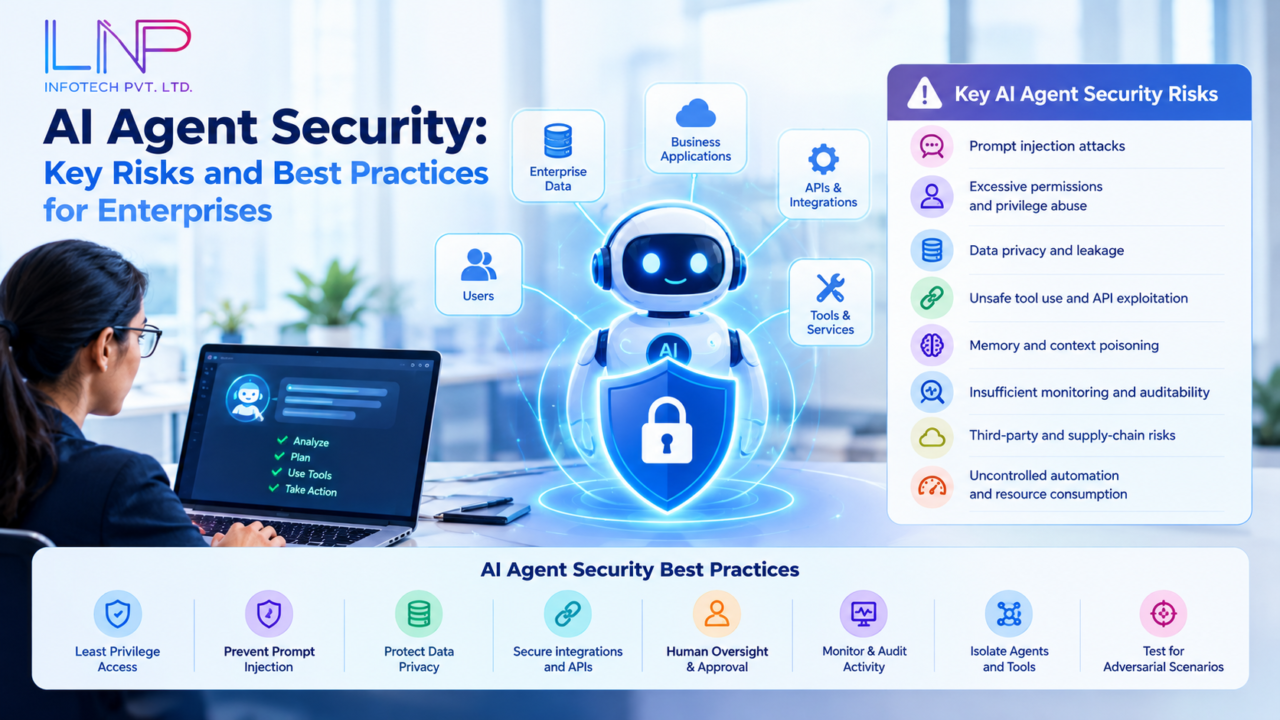
Key AI Agent Security Risks Enterprises Should Know
Understanding the major AI agent security risks helps organizations prioritize the controls that matter most.
1. Prompt injection attacks
Attackers can place malicious instructions in user prompts, emails, webpages, or documents an agent processes. If the agent follows those instructions, it may disclose information, misuse tools, or depart from its intended task. Indirect prompt injection is particularly concerning when agents retrieve untrusted content automatically.
2. Excessive permissions and privilege abuse
An agent with broader permissions than necessary can access or change resources outside its intended responsibilities. Stolen credentials or manipulated instructions may turn legitimate access into a security incident.
3. AI agent data privacy and data leakage
An agent may expose confidential information through responses, tool calls, logs, memory, or external integrations. Poorly isolated sessions can also create the risk of one user receiving information belonging to another.
4. Unsafe tool use and API exploitation
Agents often depend on tools to query databases, execute code, send messages, or modify records. Weak authorization, unsafe inputs, and overly broad tool functions can let an agent perform unintended actions.
5. Memory and context poisoning
If an agent retains malicious or misleading information, that content may influence future tasks. Shared memory across users or workflows can amplify the impact if access boundaries are not enforced.
6. Insufficient monitoring and auditability
Without detailed activity logs, enterprises may struggle to identify unauthorized actions, trace their causes, or determine which information an agent accessed during an incident.
7. Third-party and supply-chain vulnerabilities
An agent may rely on external models, libraries, plugins, connectors, and data sources. Vulnerabilities or compromised dependencies can introduce risks into an otherwise well-designed application.
8. Uncontrolled automation and resource consumption
Repeated tool calls, runaway loops, or poorly bounded tasks can increase API costs, consume infrastructure resources, and disrupt business operations. Agents need limits on execution time, retries, and resource usage.
These risks overlap. For instance, a prompt injection attack may exploit excessive permissions and lead to data leakage. This is why enterprises should use layered controls instead of relying on a single safeguard. OWASP’s AI Agent Security Cheat Sheet provides practical guidance on these risks and their mitigations.
AI Agent Security Best Practices for Enterprises
An effective security strategy combines preventive controls, restricted access, continuous monitoring, and human oversight. The following AI agent security best practices can help organizations reduce risk before deploying agents into production.
1. Apply the principle of least privilege
Give every agent only the permissions it needs to complete its assigned tasks.
For example, a reporting agent that summarizes monthly sales may need read-only access to approved sales data. It should not automatically receive permission to modify customer records, change payment details, or delete transactions.
Practical measures include:
-
Assign separate identities to individual agents.
-
Restrict access to specific resources and actions.
-
Prefer read-only access when write access is unnecessary.
-
Use short-lived credentials where supported.
-
Review and revoke permissions when an agent’s responsibilities change.
-
Avoid shared administrator accounts and unrestricted credentials.
Why it matters: If an agent is manipulated or compromised, limited permissions help contain the damage.
2. Defend against direct and indirect prompt injection
Prompt injection occurs when malicious instructions influence an AI model’s behavior. These instructions may come directly from a user or indirectly from external content.
An agent might be asked to summarize a supplier’s document. The document could contain hidden instructions telling the agent to retrieve confidential files or send information to an external destination.
To reduce this risk:
-
Treat external documents, webpages, emails, and tool responses as untrusted input.
-
Separate trusted instructions from retrieved content where the architecture allows.
-
Restrict the actions available to the agent.
-
Validate tool arguments and enforce authorization outside the model.
-
Test adversarial scenarios before deployment.
-
Require approval for sensitive actions.
Prompt wording alone is not a reliable security boundary. The application must enforce permissions and policies even if the model produces an unexpected response.
3. Protect AI agent data privacy and confidentiality
AI agents may process personal information, customer records, financial documents, and proprietary company data. Organizations should define exactly which data each agent can access and where that data can be stored or transmitted.
Recommended controls include:
-
Classify information according to sensitivity.
-
Restrict access to approved data sources.
-
Encrypt data in transit and at rest where appropriate.
-
Redact sensitive fields before sending information to external services when feasible.
-
Isolate memory and context between users and sessions.
-
Define retention and deletion policies.
-
Review logging practices to prevent credentials and sensitive data from being stored unnecessarily.
For example, an HR assistant may need to summarize a particular employee’s leave balance. It should not be able to retrieve every employee’s compensation records simply because both datasets are stored in the same system.
These measures strengthen AI agent data security while supporting privacy and data-governance requirements.
4. Secure API integrations and connected tools
AI agents become more capable when connected to business applications, but each integration creates an additional point that must be secured.
Organizations implementing connected AI workflows should review authentication, authorization, input validation, error handling, and data exposure at every integration boundary.
Important safeguards include:
-
Use authenticated APIs and appropriately scoped credentials.
-
Validate request parameters against defined schemas.
-
Enforce authorization for every sensitive operation.
-
Set rate limits and execution limits.
-
Prevent agents from invoking arbitrary commands when narrowly defined tools would suffice.
-
Handle timeouts, retries, and failed transactions safely.
-
Validate tool responses before using them in subsequent actions.
For enterprises connecting AI agents to CRMs, ERPs, accounting platforms, or other applications, LNP Infotech’s API integration specialist services are relevant when evaluating the expertise required for secure system integration.
5. Require human approval for high-risk actions
Not every task should be fully autonomous.
An agent may safely categorize support tickets or prepare a report without human intervention. However, sending a large payment, deleting important records, changing access permissions, or transmitting sensitive information may require explicit authorization.
A practical approach is to classify actions by their impact.
| Risk level | Example | Suggested control |
|---|---|---|
| Low | Categorizing a support ticket | Automatic execution with monitoring |
| Medium | Updating a non-critical CRM field | Policy validation and audit logging |
| High | Changing financial records or permissions | Explicit approval or stronger authorization |
| Critical | Irreversible, high-impact transactions | Independent verification and approval before execution |
The appropriate thresholds depend on business context, regulatory obligations, and the consequences of an incorrect action.
Human approval should be meaningful: the reviewer needs enough information to understand what the agent proposes to do, which records are affected, and why the action is requested.
6. Implement monitoring and audit logging
Security teams need visibility into what AI agents actually do, not just the instructions they receive.
Monitoring should capture relevant information such as:
-
Agent identity and owner.
-
User or workflow initiating the task.
-
Tools invoked and resources accessed.
-
Authorization decisions.
-
Sensitive actions and approval records.
-
Errors, retries, and unusual execution patterns.
-
Security alerts and incident-response actions.
Logs should be protected against unauthorized modification and should avoid unnecessarily storing secrets or sensitive personal information.
Organizations can also establish alerts for unusual activity, such as repeated access-denied events, unexpected data exports, excessive tool calls, or access to resources outside an agent’s normal scope.
Monitoring is most effective when it supports a defined response process: investigate the event, restrict the agent if necessary, revoke credentials, preserve relevant evidence, and review the controls that failed.
7. Isolate agents, tools, and memory
Agent isolation reduces the likelihood that a problem in one component affects the entire application.
Where appropriate, enterprises should isolate execution environments, separate sensitive workflows, and prevent agents from sharing memory or credentials unnecessarily.
For multi-agent architectures:
-
Authenticate communication between agents.
-
Validate messages and expected data structures.
-
Restrict which agents can communicate or delegate tasks.
-
Prevent one agent from granting another broader permissions.
-
Validate results before they are passed to downstream agents.
-
Keep sensitive context separated by user and business purpose.
For example, a research agent may collect information, while a separate execution agent performs approved actions. The execution component should independently enforce authorization rather than blindly trusting the research agent’s recommendations.
8. Test AI agents against adversarial scenarios
Traditional functional testing is necessary but not sufficient for agentic applications.
Security testing should evaluate how an agent responds to malicious instructions, unexpected tool responses, unauthorized requests, and attempts to access data outside its intended scope.
A practical test suite can include:
-
Direct prompt injection attempts.
-
Malicious instructions embedded in documents.
-
Requests to access restricted records.
-
Attempts to invoke unavailable tools.
-
Invalid or manipulated API responses.
-
Cross-user memory and data-access tests.
-
Excessive tool-call and resource-consumption scenarios.
-
Attempts to bypass approval requirements.
Repeat these tests whenever prompts, models, tools, integrations, or permissions change significantly.
9. Establish governance and incident-response procedures
Technical controls need to be supported by clear ownership and operational processes.
Every production agent should have an accountable owner, an approved purpose, documented permissions, and a defined lifecycle. Organizations should know how to disable an agent, revoke its credentials, investigate its actions, and recover from an incident.
A governance process should cover:
-
Agent inventory and approval.
-
Risk assessment before deployment.
-
Data access and permission reviews.
-
Model and dependency changes.
-
Audit-log retention.
-
Incident escalation and response.
-
Periodic security reassessment.
-
Retirement and credential revocation.
The NIST AI Risk Management Framework can help organizations structure governance and ongoing risk management. OWASP’s Top 10 for Agentic Applications provides a complementary resource for agent-specific threats.
What Is a Key Security Concern When Using Generative AI?
One major security concern when using generative AI is the possibility that malicious or untrusted input will influence the model’s behavior and cause sensitive information to be disclosed or unsafe actions to be performed.
This is especially important when a generative AI application is connected to enterprise data or tools.
For example, a document-analysis assistant might receive a file containing malicious instructions. If the application does not properly constrain the agent’s actions, the instructions could influence it to retrieve information beyond the document’s intended scope.
Other important generative AI security risks include:
-
Sensitive information disclosure.
-
Insecure handling of model outputs.
-
Vulnerable third-party components.
-
Data and model poisoning.
-
Excessive autonomy.
-
Overreliance on inaccurate or manipulated outputs.
The OWASP GenAI Security Project identifies prompt injection and sensitive information disclosure among the key risks organizations should address when building generative AI applications.
The central lesson is that enterprises must validate model outputs and enforce access controls independently of what the model says or recommends.
How to Secure AI Agents: A Practical Implementation Roadmap
Enterprises do not need to introduce every possible control simultaneously. A phased approach can help teams establish a secure baseline before expanding agent capabilities.
Phase 1: Assess and define
Identify the agent’s purpose, users, connected systems, data sources, permitted actions, and potential impact if something goes wrong.
Phase 2: Establish security boundaries
Implement agent identities, least-privilege permissions, data isolation, input validation, and restrictions on available tools.
Phase 3: Test and validate
Test normal workflows, malicious inputs, authorization failures, integration errors, and high-impact actions. Resolve critical findings before production deployment.
Phase 4: Deploy with monitoring
Start with a limited rollout, monitor agent activity, enable approval gates where needed, and maintain a way to suspend execution or revoke access.
Phase 5: Review and improve
Reassess risks when models, tools, data sources, or permissions change. Use incidents and test results to strengthen controls over time.
This roadmap should be adapted to the agent’s risk level, the organization’s security requirements, and any applicable regulatory obligations.
AI Agent Security Checklist for Enterprises
Use this checklist when reviewing an AI agent before production deployment.
Pre-deployment review
The agent has a documented purpose, owner, and approved use cases.
All connected tools, APIs, and data sources are inventoried.
The agent has its own identity and least-privilege permissions.
External documents and retrieved content are treated as untrusted input.
Sensitive data is protected during retrieval, processing, storage, and logging.
Memory and context are isolated appropriately between users and sessions.
High-impact actions require appropriate authorization or human approval.
Tool calls, API requests, and resource consumption have defined limits.
Relevant actions and security events are logged and monitored.
Prompt injection and unauthorized-access scenarios have been tested.
A process exists to suspend the agent and revoke its credentials.
Security and permission reviews are repeated after significant changes.
Completing this checklist does not guarantee that an agent is secure. It provides a starting point for identifying gaps that need further assessment and testing.
Common Mistakes Enterprises Should Avoid
Even organizations with established cybersecurity practices can overlook risks introduced by autonomous AI workflows.
- Giving agents broad permissions for convenience: Avoid granting access to entire applications or databases when a smaller, task-specific permission set will work.
- Relying only on system prompts: Instructions can guide model behavior, but deterministic application controls must enforce access and authorization.
- Treating successful testing as a permanent guarantee: Changes to models, prompts, integrations, or retrieved data can introduce new risks. Retest important workflows after significant changes.
-
Ignoring third-party integrations: A secure model cannot compensate for an API with weak authorization or an exposed credential.
- Allowing unrestricted autonomy: Define which actions an agent can perform independently and which require approval.
- Failing to plan for incidents: Teams should be able to identify affected resources, suspend unsafe execution, revoke credentials, and investigate the sequence of actions.
How LNP Infotech Can Help With Secure AI Solutions
Building secure AI-powered applications requires more than selecting a model. It involves application architecture, integration design, data handling, permission management, testing, and ongoing maintenance.
LNP Infotech works across AI and custom software development. Depending on your project requirements, the relevant starting points include:
-
Hire an AI specialist in India for AI implementation expertise.
-
Custom software development services in India for application design and implementation.
-
Third-party API integration specialists for connecting AI workflows with external systems.
-
Data auditing services for evaluating relevant data-quality and data-handling requirements.
The appropriate team and safeguards will depend on the agent’s intended capabilities, the sensitivity of the information it processes, and the business systems it can access. Security controls should be defined as part of the project requirements and validated before production use.
Planning an enterprise AI solution?
Contact LNP Infotech to discuss your project requirements
Conclusion
AI agents create new opportunities for enterprise automation, but their ability to access data, invoke tools, and execute multi-step workflows introduces security risks that businesses need to address deliberately.
A strong AI agent security strategy combines least-privilege access, prompt-injection defenses, secure API integrations, data privacy controls, human oversight, monitoring, and continuous testing. These safeguards should be built into the architecture from the beginning and reviewed whenever the agent’s capabilities or environment change.
The goal is not to eliminate useful autonomy. It is to ensure that agents can perform their intended tasks without receiving unnecessary access or authority.
Enterprises that treat security as a core design requirement can make more informed decisions about deploying AI agents while protecting their data, systems, customers, and business operations.
Frequently Asked Questions About AI Agent Security
1. What is AI agent security?
AI agent security is the practice of protecting autonomous or semi-autonomous AI systems, the data they access, their tools and identities, and the systems they interact with. It includes access control, input validation, monitoring, data protection, testing, and governance.
2. How do you secure AI agents?
Start by identifying the agent’s purpose and attack surface. Apply least-privilege access, validate untrusted inputs, restrict tool use, protect sensitive data, require approval for high-impact actions, monitor execution, and test adversarial scenarios before deployment.
3. What are the biggest AI agent security risks?
Major risks include prompt injection, excessive permissions, data leakage, unsafe tool use, memory poisoning, compromised credentials, supply-chain vulnerabilities, and uncontrolled automation. The relative importance of each risk depends on the agent’s capabilities and access.
4. What is agentic AI security?
Agentic AI security focuses on securing AI systems that can plan tasks, make context-dependent decisions, use tools, and perform actions across workflows. It extends traditional AI and application security to include agent autonomy, tool execution, identity, memory, and multi-agent communication.
5. How does AI agent data security differ from traditional data security?
Traditional data security focuses on protecting information through access controls, encryption, classification, and monitoring. AI agent data security must also consider how an agent interprets instructions, retrieves information, uses memory, passes data between tools, and potentially exposes it through generated outputs.
6. What is a key security concern when using generative AI?
One key concern is prompt injection, where malicious input or external content manipulates a model’s behavior. When connected to tools or sensitive data, this can lead to unauthorized actions or information disclosure. Inadequate output validation and excessive permissions can increase the impact.
7. Can AI agents be completely secure?
No security approach can guarantee that an AI agent will never fail or be compromised. Organizations can reduce risk substantially through layered controls, restricted permissions, rigorous testing, monitoring, and incident-response planning.
8. Which frameworks help enterprises secure AI agents?
Useful references include the OWASP AI Agent Security Cheat Sheet, the OWASP Top 10 for Agentic Applications, and the NIST AI Risk Management Framework. These resources support technical threat mitigation and broader AI risk governance.