

Claims processing is where insurance operations either earn trust or lose it. It’s the moment a policyholder finds out what their coverage actually means in practice — and for decades, that moment has meant waiting. Paper intake forms, manual document review, adjusters juggling spreadsheets, and claims sitting in a queue for weeks before anyone even looks at them.
That’s changing fast. Insurers using AI-powered claims automation are now resolving claims in a fraction of the time it used to take, and the gap between carriers who’ve modernized and those still running manual workflows is widening every quarter. If you’re an insurance leader wondering where to start with AI, claims processing is very often the right first move — not because it’s easy, but because it’s the part of the business where automation pays for itself the fastest.
This is a practical look at what claims automation actually involves, what results carriers are seeing, and how to roll it out without betting your entire operation on day one.
Why Start With Claims Processing?
Underwriting, policy administration, distribution — insurers have a long list of places AI could theoretically help. Claims processing tends to win out as the starting point for a few concrete reasons:
- The pain is measurable. Claims cycle time, cost per claim, and customer satisfaction scores are already tracked at most carriers, which makes it easy to prove ROI.
- The workflow is repetitive. A large share of claims — especially routine, low-complexity ones — follow predictable patterns that are well-suited to automation.
- The upside is immediate. Faster claims resolution directly improves retention, since claims handling is one of the biggest drivers of policyholder churn.
Industry data backs this up. As of 2025, the large majority of insurers report using AI somewhere in their claims process, and claims automation is considered the most mature AI deployment across the industry, ahead of underwriting or distribution.
What Does AI Actually Automate in Claims?
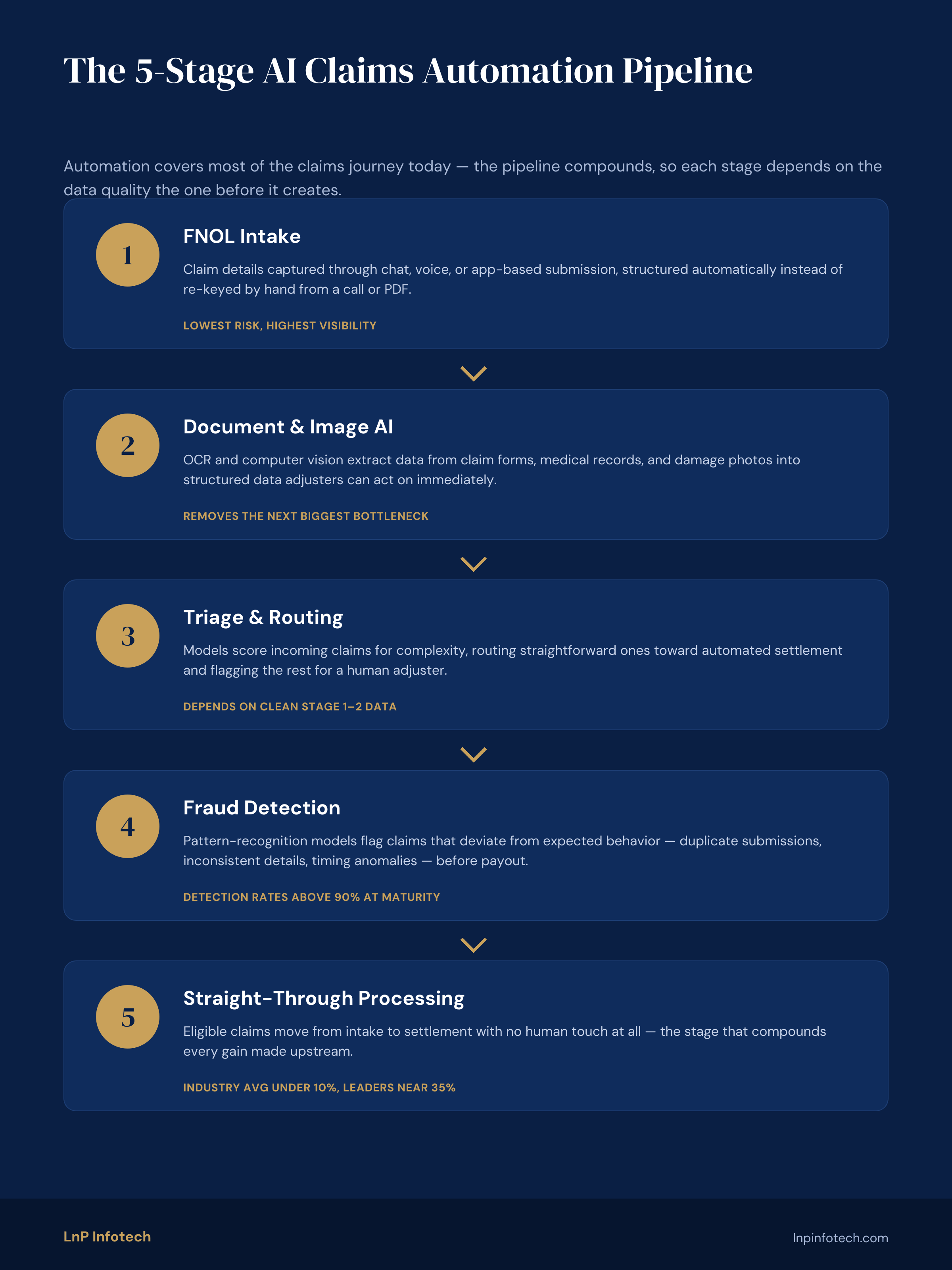
“AI claims automation” covers a broader pipeline than most people expect — a layered set of capabilities that typically get introduced in this order:
1. First Notice of Loss (FNOL) intake. AI-driven intake captures claim details through chat, voice, or app-based submission and structures the data automatically, instead of a human re-keying it from a phone call or PDF.
2. Document and image processing. Optical character recognition and computer vision extract information from claim forms, medical records, and damage photos — turning unstructured documents into structured data adjusters can act on immediately.
3. Triage and routing. Machine learning models score incoming claims for complexity and route the straightforward ones toward automated settlement, while flagging anything unusual for a human adjuster.
4. Fraud detection. Pattern-recognition models flag claims that deviate from expected behavior — duplicate submissions, inconsistent details, timing anomalies — for further review before payment goes out.
5. Straight-through processing (STP) and payment. For eligible claims, the system can move from intake to settlement with no human touch at all.
The trend line for 2026 is that automation now covers most of the front end of the claims pipeline — intake, triage, STP, damage estimating, and fraud flagging all have established software approaches. The one part that’s stayed stubbornly manual is the deep investigation of flagged claims, which is where Special Investigation Unit (SIU) teams still do the heavy lifting.
How Much Difference Does This Actually Make?
The numbers being reported across the industry right now are hard to ignore:
- Carriers using AI-enabled claims workflows have cut resolution time dramatically — from roughly 30 days down to about a week for the average claim, with routine claims often settling within 24–48 hours.
- Cost per claim has dropped by roughly 30–40% at carriers with mature automation, driven by fewer manual touchpoints per file.
- Fraud detection systems built on modern AI models are now achieving detection rates above 90%, with false-positive rates under 5% — a level of precision that used to be available only to large carriers with dedicated data science teams.
Straight-through processing is the metric worth watching most closely if you’re evaluating your own operation. Industry-wide, STP rates in property and casualty claims still sit under 10%, with a significant share of insurers reporting no STP at all — while top personal-lines carriers are already approaching 35% on eligible claim types. That gap between the industry average and the leaders is essentially the size of the opportunity still on the table.
What’s the Smartest Way to Roll This Out?
The carriers seeing the fastest ROI share one habit: they don’t try to automate everything at once. A phased rollout consistently outperforms a big-bang implementation, both on speed to value and on total cost. A practical sequence looks like this:
- Map your current state first. Before evaluating any vendor or writing a line of code, measure your current STP rate by line of business. This tells you exactly where manual intervention is still dominant and where automation will have the most immediate impact.
- Start with FNOL. Automating intake is the lowest-risk, highest-visibility place to begin — it improves the policyholder’s first impression immediately and generates clean structured data for everything downstream.
- Add document AI next. Once intake is automated, document and image processing removes the next biggest manual bottleneck: getting information out of forms, photos, and records.
- Layer in fraud analytics and reserve modeling. With clean, structured data flowing in, fraud detection models become far more accurate, and reserve estimates become more reliable.
- Build the real-time policyholder portal last. This is where all the upstream automation becomes visible to the customer — live status updates instead of a black box.
This sequencing matters because each stage depends on the data quality created by the one before it. Trying to bolt on fraud detection before your intake and document processing are automated tends to produce noisy, unreliable results.
Where Does Human Judgment Still Matter?
Not every claim should go through STP, and the carriers getting this right in 2026 aren’t the ones automating every file — they’re the ones correctly identifying which claims can be automated safely and which need a human adjuster’s judgment, then building systems that handle both well.
Deep investigation of flagged claims remains largely a manual process, typically handled by SIU teams, and it’s the one part of the pipeline without an established software solution. That’s actually the next major efficiency opportunity in the industry — extending structured investigation support to a much larger share of flagged claims, rather than continuing to push more automation into the front end where returns are already diminishing.
What About Regulation and Explainability?
Insurers can’t skip this part. State-level regulation of claims-specific AI is still evolving, and insurers are required to maintain complete decision audit trails and clear explanations for any adverse claim decision, in line with existing fair claims practices statutes. Any automation you build needs to log why a claim was routed, flagged, or denied — not just what happened. Build that in from day one. Bolting it on after an audit forces the issue is a lot more expensive.
Starting Without Betting the Whole Operation
You don’t need a large data science team or a multi-year transformation program to get started. Cloud-based platforms have made fraud detection and claims automation accessible to mid-size agencies and MGAs for the first time — capabilities that used to be exclusive to large carriers. The practical starting point is usually a scoped pilot: one line of business, one stage of the pipeline, measured against your baseline STP rate and cost per claim, before you expand further.
How We’d Approach This?
A full claims automation build sounds like a multi-year IT project, but it doesn’t have to start that way. When we scope this for an insurance client, it looks like this:
- Week 1–2: Baseline audit. We measure your current STP rate, cost per claim, and average cycle time by line of business — so we know exactly where the friction is before recommending anything.
- Week 3–6: Automate FNOL first. Intake through chat, voice, or app-based submission, structured automatically instead of re-keyed by hand. This is the lowest-risk stage and the one policyholders notice immediately.
- Week 7–10: Add document and image AI. OCR and computer vision pull data from claim forms, records, and damage photos, feeding clean structured data into everything downstream.
- Week 11–14: Layer in triage and fraud flagging. With clean intake data flowing in, routing and fraud models get meaningfully more accurate than if we’d started here.
- Ongoing: Expand toward STP. Once the pipeline is stable and measured against your baseline, we extend straight-through processing to more claim types, one line of business at a time.
Same discipline we apply everywhere: prove the smallest piece first, then earn the right to expand it. A claims operation that’s automated FNOL and document processing well is in a much stronger position to add fraud detection and STP than one trying to do all five stages simultaneously.
Frequently Asked Questions
How much does claims automation cost? 3
It scales with how many stages you automate. FNOL intake alone is a relatively contained build; a full pipeline through STP is a bigger investment spread across phases. We give you real numbers after the baseline audit, not before we know what we’re actually automating.
Do we need clean historical data to start?
Not for FNOL automation — that’s forward-looking and doesn’t depend on your historical claims data being pristine. Fraud detection and triage models do benefit from clean historical data, though, which is one reason we sequence document AI before those stages.
Will this disrupt our current claims operation?
No. We design for parallel running wherever possible, so the new pipeline proves itself alongside your existing process before anything gets switched off.
We already have some automation in place — can you build on it?
Usually, yes. Most carriers have automated a piece or two already, often FNOL or a basic CRM integration. The baseline audit tells us what’s already working and where the actual gaps are, rather than assuming we’re starting from zero.
How does this handle regulatory compliance?
Every automated decision — routing, flagging, denial — gets a documented audit trail from day one. That’s required under existing fair claims practices statutes, and it’s part of the architecture, not something added after an audit asks for it.
What’s a realistic timeline for the whole pipeline?
FNOL and document AI can be live within about ten weeks. Triage, fraud flagging, and expanded STP take longer and depend on your claims volume and complexity — a full rollout for a mid-size line of business typically runs several months, phased so you see value at every stage rather than waiting for one big launch.
Let’s Automate Your Claims Process
If your claims operation is still running on manual queues, spreadsheets, and re-keyed PDFs — and you want to move toward faster resolution without a multi-year transformation project — we’d like to talk.
At LnP Infotech, we build AI-powered claims automation that connects to your existing policy and claims systems through clean, well-documented API integrations, with the audit trails and explainability regulators expect designed in from day one — not bolted on afterward.
Here’s what a scoped claims automation pilot with LnP Infotech includes:
- ✅ Baseline STP and cost-per-claim audit before we build anything
- ✅ Automated FNOL intake across chat, voice, or app-based submission
- ✅ Document and image AI to extract data from forms, records, and damage photos
- ✅ Fraud detection and triage models tuned to your claim types
- ✅ Full decision audit trails for regulatory compliance
- ✅ Integration with your existing policy administration and claims systems
- ✅ Phased rollout — one line of business, measured against your baseline, before you scale further
Your claims backlog shouldn’t be the reason a policyholder loses trust in you.
👉 Talk to LnP Infotech — Tell us where your claims process is slowest. We’ll show you what a phased automation rollout looks like for your operation.