
Published: August 2026 | Reading Time: 13 min | Category: AI & Software Development
There is a version of software development that most businesses still believe in the one where you hire a team of developers, wait six to twelve months, spend $100,000 or more, and hope the product that comes out the other side still matches the problem you set out to solve.
At LnP Infotech, we stopped working that way.
Not because we cut corners. Because the tools available in 2026 make that approach genuinely obsolete for a wide range of SaaS products and our clients deserve faster, leaner delivery without sacrificing quality or scalability.
This article explains exactly how we use AI Codex to build SaaS applications for our clients what the process looks like, where it saves time, where we still apply engineering judgment, and what it means for businesses that come to us with a product idea and a deadline.
Why We Integrated AI Codex Into Our Development Process
The global SaaS market reached $465 billion in 2026. The AI-created SaaS segment alone is valued at $142 billion, growing at 39.6% annually. Every business we work with whether in PropTech, healthcare, finance, or enterprise software is under pressure to move faster than their competitors without inflating their development budget.
AI Codex, in its 2026 form, is not the autocomplete tool it was in 2021. It is a cloud-based autonomous AI agent that runs on GPT-5.5 OpenAI’s most capable model. It plans, writes, tests, debugs, and deploys code across a full software project. It works in sandboxed environments, connects to development tools and repositories, and handles multi-step engineering workflows autonomously.
More than 3 million developers use Codex every week. We use it as a core part of our delivery process not to replace engineering judgment, but to apply that judgment at a higher level while Codex handles the execution at speed.
The result: SaaS products that used to take 4–6 months to deliver now reach working MVP stage in 2–4 weeks. Development costs that used to start at $50,000 now start significantly lower. And our clients get to validate their product with real users before committing to a full build which changes the risk profile of software investment entirely.
What “No Code” Actually Means in Our Process
When we say we build SaaS applications without writing a single line of code manually, we want to be clear about what that means and what it doesn’t.
It doesn’t mean the product has no code. Every application we deliver is a fully functional, deployable software product with a real codebase, a real database, real authentication, and real payment infrastructure.
What it means is that our team directs AI Codex using structured natural language describing architecture, features, data models, user flows, and logic in plain English and Codex generates, tests, and validates the implementation. Our engineers review the output, identify edge cases, apply security checks, and make the judgment calls that AI cannot reliably make on its own.
Think of it less like “no code” in the traditional sense and more like the difference between a senior architect who designs every structural detail versus one who directs a highly capable team to execute a well-defined vision. The architect’s expertise drives the outcome. The execution happens at scale.
Our Build Process: From Brief to Deployed Product
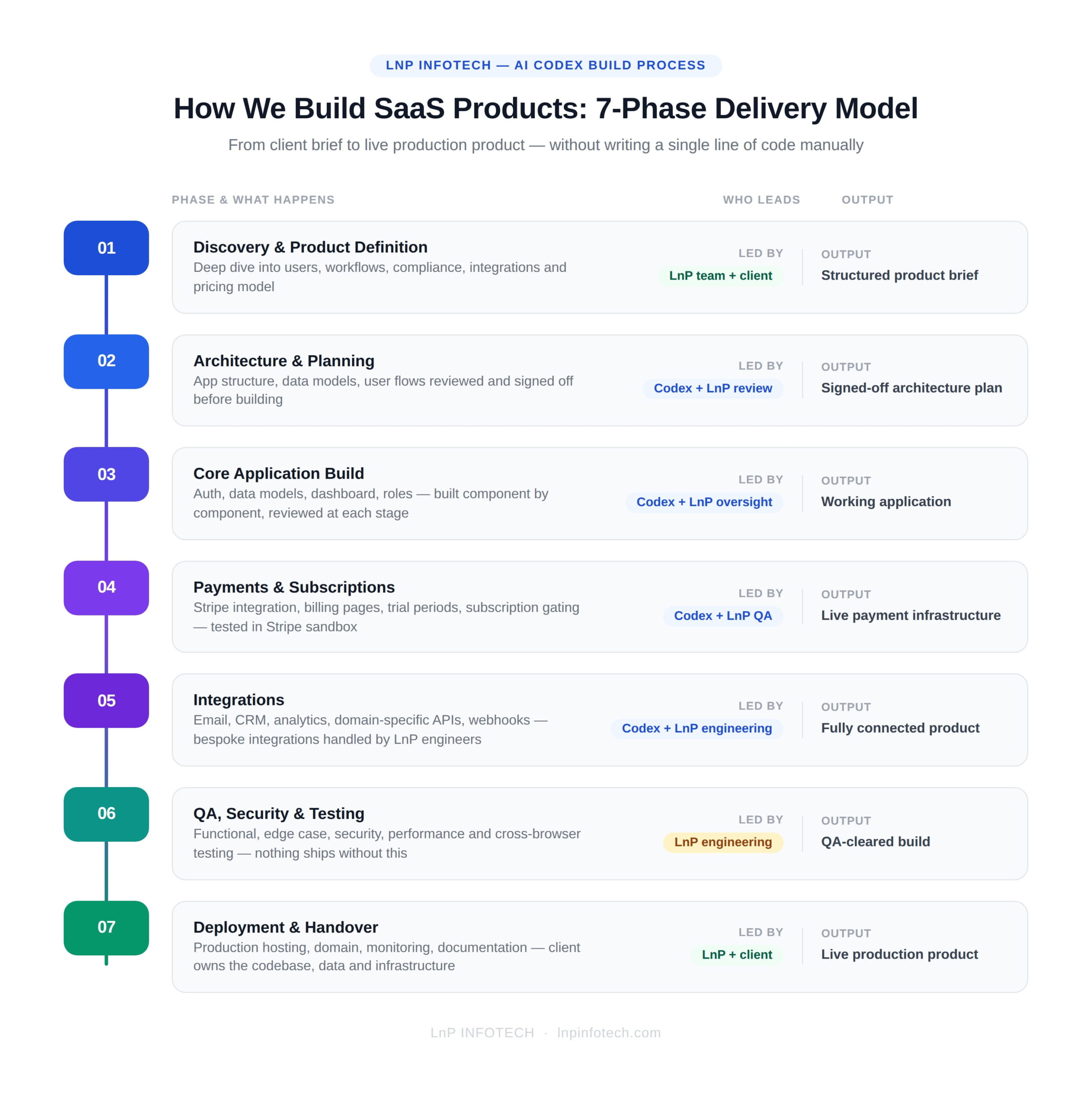
Here is how a typical SaaS engagement works when we apply the AI Codex development model.
| Phase | What Happens | Who Does It | Output |
|---|---|---|---|
| 1. Discovery | Requirements, users, workflows, compliance | LnP team + client | Structured product brief |
| 2. Architecture | App structure, data models, user flows | Codex + LnP review | Signed-off architecture plan |
| 3. Core Build | Auth, data, dashboard, roles | Codex + LnP oversight | Working application |
| 4. Payments | Stripe integration, subscriptions, billing | Codex + LnP QA | Live payment infrastructure |
| 5. Integrations | Email, CRM, APIs, webhooks | Codex + LnP engineering | Connected product |
| 6. QA & Security | Testing, security review, performance | LnP engineering | QA-cleared build |
| 7. Deployment | Hosting, domain, monitoring, handover | LnP + client | Live production product |
Phase 1 – Discovery and Product Definition
Every build starts with deep discovery. Before we open Codex, we spend time with the client understanding:
- Who the end users are and what problem the product solves for them
- What the core workflow looks like the three to five things the product must do to be valuable
- What data needs to be captured, stored, and surfaced
- How users will be charged subscription tiers, usage-based pricing, or one-time payment
- What integrations are needed CRMs, payment providers, data feeds, third-party APIs
- What compliance or security requirements apply
This phase is where most software projects go wrong not in the building, but in the not-understanding. We invest heavily here because every unclear requirement that makes it into a prompt costs more to fix after it’s been built than before.
The output of discovery is a structured product brief a clear, specific description of the application that becomes the foundation for every Codex prompt that follows.
Phase 2 – Architecture and Planning
With the product brief in hand, we use Codex to generate an application architecture before writing a line of code. This includes:
- The main views and screens the application needs
- The data models and how they relate to each other
- The core user flows what happens when a user signs up, creates a record, completes a key action
- The integration points where external services connect to the application
- The authentication and authorization model who can see what
We review this architecture with the client. It is easier to catch a misunderstanding at the architecture stage than to rebuild a feature after it has been implemented. This review also surfaces decisions the client needs to make pricing structure, user role permissions, data retention policies before they are baked into the build.
Phase 3 – Core Application Build
Once the architecture is signed off, Codex builds the core application. Our engineers direct this process using structured prompts that translate the product brief into specific, reviewable build tasks one component at a time.
A typical core build includes:
User authentication and account management: sign up, log in, email verification, password reset, and profile management. Data isolation between users is enforced at the database level using row-level security policies.
Core data models and CRUD functionality: the primary entities the application manages (properties, tenants, clients, orders, cases whatever the product works with), with the ability to create, view, update, and delete records.
Dashboard and navigation: the main interface users land on after logging in, surfacing the information they need most and providing clear navigation to every core function.
Permissions and roles: for multi-user products, defining what different user types can see and do within the application.
Codex works in a sandboxed environment during this phase. Each component is built, tested against the spec, and validated before the next is started. Our engineers review output at each stage not rubber-stamping, but actively checking logic, data handling, and edge cases.
Phase 4 – Payments and Subscription Infrastructure
Every SaaS product we build includes full payment infrastructure. We integrate Stripe the industry standard configured to match the client’s pricing model.
For subscription products, this means:
- A pricing page with the client’s chosen plans and billing frequencies
- Stripe Checkout for secure payment capture
- Subscription lifecycle management trial periods, upgrades, downgrades, cancellations
- Webhook handling so the application responds correctly when a subscription is created, renewed, or cancelled
- A billing management page where users can view and manage their subscription
- Access gating users without an active subscription cannot access the product
We test every payment flow with Stripe’s test environment before the client ever goes live with real users.
Phase 5 – Integrations
Most SaaS products need to talk to other systems. Common integrations we handle in this phase include:
- Email: transactional emails (welcome, password reset, notifications) via Resend or SendGrid
- CRM: connecting the product to the client’s existing CRM for lead or customer data
- Analytics: embedding product analytics so the client can see how users behave inside the application
- Third-party data: connecting to property data feeds, healthcare APIs, financial data providers, or any other domain-specific data source the product depends on
- Webhooks and automation: triggering actions in external tools when events happen inside the application
Codex handles standard integrations well. For bespoke or poorly-documented APIs, our engineers take a more hands-on role writing the integration wrapper ourselves and using Codex for the surrounding implementation.
Phase 6- Review, Testing and QA
Before anything reaches the client for review, we run our own QA process. This includes:
- Functional testing of every core user flow
- Edge case testing what happens when a user tries to break the application in expected ways
- Security review checking authentication logic, data isolation, input validation, and API security
- Performance checks ensuring the application loads quickly and handles concurrent users without degradation
- Cross-browser and mobile testing verifying the UI works correctly across devices and browsers
AI-generated code is not automatically bug-free. Our QA process exists specifically to catch what Codex misses particularly in edge cases, complex conditional logic, and security-sensitive areas.
Phase 7 – Deployment and Handover
Once QA is complete and the client has signed off on the review build, we deploy to production. Our standard stack uses Vercel for hosting, Supabase for the database, and Stripe for payments all of which are production-grade infrastructure used by companies ranging from early-stage startups to public enterprises.
We configure:
- Production environment variables and secrets management
- Custom domain connection and SSL certificate
- Database backups and monitoring
- Error tracking and alerting
- Deployment pipeline for future updates
After deployment, we provide the client with full documentation what the application does, how it’s structured, what each integration does, and how to manage it going forward. The client owns the codebase, the infrastructure, and the data.
Real-World Applications We’ve Built This Way
The AI Codex development model isn’t theoretical for us. Here are the types of SaaS products we’ve delivered using this approach across our core verticals.
Featured Example: Bizukti
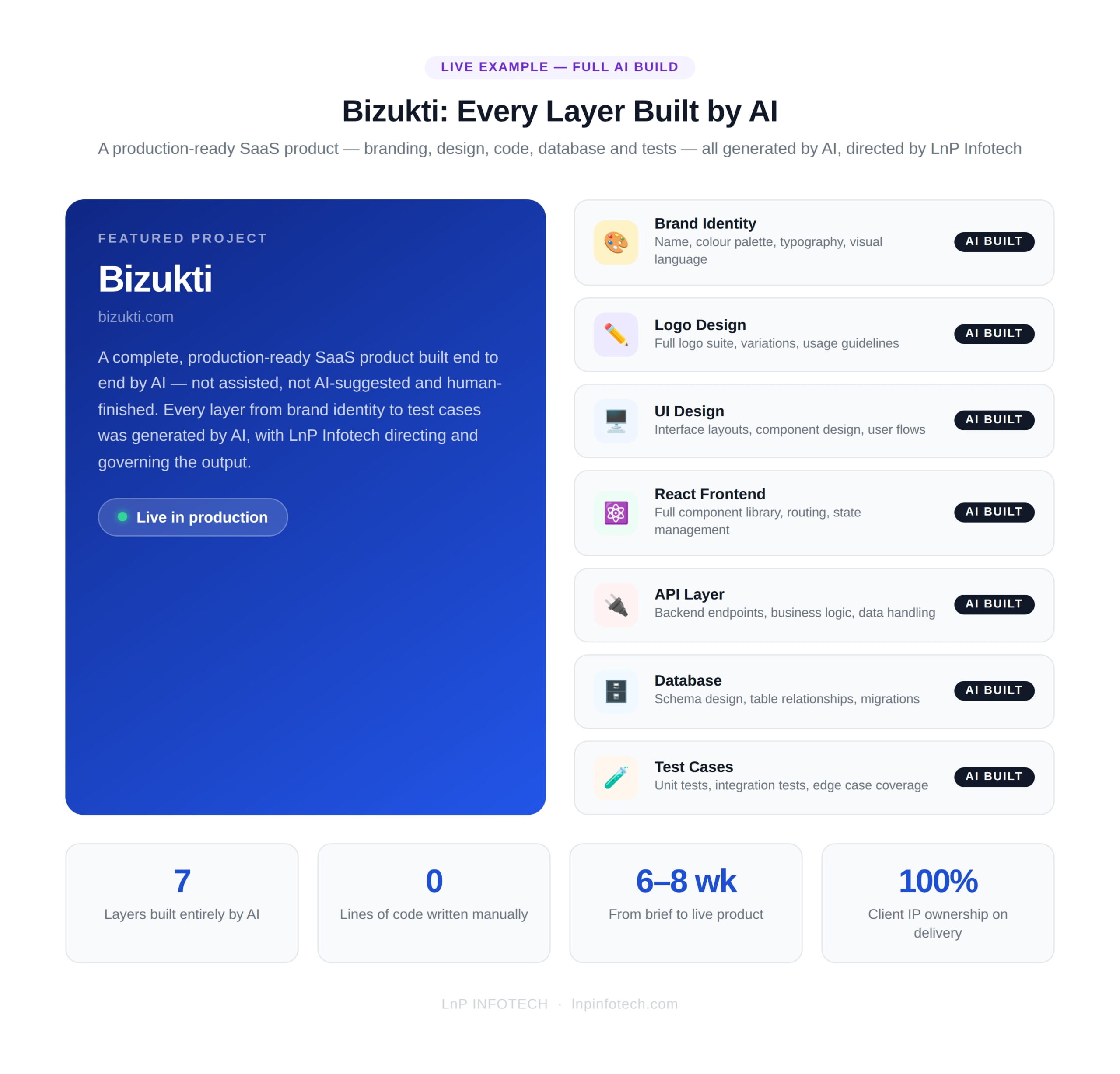
Bizukti is one of the clearest demonstrations of what full-stack AI development looks like in practice and it’s live.
Every layer of the product was built by AI: branding, logo design, UI design, React frontend, API code, database architecture, and test cases. Not assisted by AI. Not AI-suggested and human-finished. Built by AI, end to end with our team directing, reviewing, and governing the output at each stage.
What Bizukti represents isn’t a novelty. It is the proof that a complete, production-ready SaaS product with a coherent brand identity, a functional frontend, a working backend, integrated APIs, a structured database, and a tested codebase can be delivered without a single line of code being written by hand.
The stack behind it:
| Layer | What Was Built | Built By |
|---|---|---|
| Brand identity | Name, colour palette, typography, visual language | AI |
| Logo design | Full logo suite, variations, usage guidelines | AI |
| UI design | Interface layouts, component design, user flows | AI |
| React frontend | Full component library, routing, state management | AI |
| API layer | Backend endpoints, business logic, data handling | AI |
| Database | Schema design, table relationships, migrations | AI |
| Test cases | Unit tests, integration tests, edge case coverage | AI |
This is the development model we bring to every SaaS engagement. Bizukti is the evidence that it works.
Industries We’ve Delivered This Way
Across our core verticals, the AI Codex model consistently compresses timelines and cuts cost while our engineering layer handles what makes each domain genuinely complex.
| Vertical | Products We Build | Where Our Engineering Team Steps In |
|---|---|---|
| PropTech | Property management platforms, tenant portals, lease systems, maintenance trackers, rent collection tools | MLS/IDX integrations, multi-portfolio data isolation, real estate compliance |
| Healthcare | Prior auth workflow tools, patient intake apps, care coordination dashboards, clinical documentation systems | HIPAA-aware data architecture, access control design, audit trail requirements |
| Finance | Loan origination interfaces, client onboarding portals, investment reporting dashboards, compliance trackers | Document workflow logic, third-party financial API integrations, data validation |
| Enterprise | Internal tools, workflow automation platforms, reporting dashboards, legacy system interfaces | ERP and data warehouse connectors, proprietary API integrations, governance requirements |
Real estate SaaS has well-defined, repeatable workflows the kind Codex builds fast and accurately. Healthcare demands a careful security architecture that our team designs and validates. Finance brings complex document and data integration requirements our engineers handle directly. Enterprise clients often need connectors to existing systems no AI tool can reliably build alone.
The model is the same across all four: Codex moves fast on what’s standard; our team handles what isn’t.
What This Means for Businesses That Work With Us
If you come to LnP Infotech with a SaaS product idea, here is what working with us looks like in concrete terms compared to a traditional development agency.
| What you get | Traditional agency | LnP + AI Codex |
|---|---|---|
| Time to working MVP | 4–6 months | 2–4 weeks |
| Validate with real users | After months of build | Within weeks of brief |
| Iteration speed | Weeks per feature | Days per feature |
| IP & code ownership | Yours | Yours |
| Production readiness | Full | Full |
| Engineering oversight | Full dev team | Senior LnP review layer |
| Entry cost | $50,000–$150,000+ | Significantly lower |
| Risk if idea needs pivoting | High – sunk cost | Low – fast and lean |
The right approach isn’t always the fastest or the cheapest in isolation. It’s the one that gets your product validated, owned, and scalable without betting everything on a six-month build before a single user has seen it.
Where AI Codex Has Limits And What We Do About It
We believe in being honest about this, because overpromising on AI capabilities is one of the fastest ways to damage a client relationship.
| Area | Codex handles it well | Needs LnP engineering input |
|---|---|---|
| Standard CRUD applications | ✅ Yes | — |
| User authentication & data isolation | ✅ Yes | — |
| Stripe subscription integrations | ✅ Yes | — |
| Email integrations (Resend, SendGrid) | ✅ Yes | — |
| Popular third-party APIs | ✅ Yes | — |
| Basic reporting & data visualization | ✅ Yes | — |
| Complex business logic & algorithms | ⚠️ Partial | ✅ LnP engineers lead |
| HIPAA / SOC 2 / PCI-DSS compliance | ⚠️ Foundation only | ✅ Full security review required |
| High-scale architecture (10K+ users) | ⚠️ Needs design upfront | ✅ LnP architects the approach |
| Obscure or proprietary API integrations | ⚠️ Unreliable | ✅ LnP engineers write it |
Our job is to know where Codex is the right tool and where it isn’t and to apply the right approach in every situation.
Frequently Asked Questions
Here are the questions we hear most often from businesses evaluating AI-accelerated SaaS development.
Is AI Codex-built software production-ready?
Yes, when built with proper engineering oversight. The applications we deliver are hosted on production-grade infrastructure, have real security controls, and are supported by full documentation. They are not prototypes.
Do we get access to the source code?
Yes. Every client receives full ownership of the codebase, database, and infrastructure. Nothing is locked to our systems or proprietary platforms.
What happens when the product needs to scale beyond what the AI-built MVP supports?
We plan for this from the start. Our architecture choices Supabase, Vercel, Stripe are used by companies at significant scale. When a client’s product grows beyond what the initial architecture supports, we provide a clear scaling roadmap and can execute it as a follow-on engagement.
Do you only use AI Codex, or do you also do traditional development?
Both. We use the right tool for the situation. AI Codex accelerates delivery for a wide range of SaaS products. For highly complex, security-critical, or enterprise-scale builds, we apply traditional development with AI augmentation. Many of our engagements combine both.
How do you ensure security in AI-generated code?
Our QA process includes a dedicated security review for every build checking authentication logic, data isolation, input validation, API security, and dependency vulnerabilities. We do not ship AI-generated code without this review.
Let’s Build Your SaaS Product
If you have a SaaS idea and want to move from concept to live product in weeks rather than months without the cost and risk of a traditional development engagement we’d like to talk.
At LnP Infotech, we combine the speed of AI Codex with the engineering judgment that turns generated code into production-ready software. The result is a delivery model that gives our clients a genuine competitive advantage not just in how fast they get to market, but in how confidently they can iterate once they’re there.
Here’s what you get when you build with LnP Infotech:
- ✅ Full SaaS product built and deployed in 2–4 weeks
- ✅ AI Codex-accelerated development with senior engineering oversight
- ✅ Authentication, database, payments and core features included
- ✅ Third-party integrations CRM, email, analytics, domain-specific APIs
- ✅ Security review and QA before every deployment
- ✅ Full IP ownership your code, your data, your infrastructure
- ✅ Ongoing development partnership for iteration and scaling
Your product idea deserves to be tested in the market, not stuck in a development backlog.
👉 Talk to LnP Infotech Tell us what you’re building. We’ll tell you how fast we can get it live.