
Published: July 2026 | Reading Time: 13 min | Category: AI & Software Development
Not long ago, the question was whether AI had any real place in software development. Today, that question feels almost quaint.
92% of US developers use AI coding tools daily. GitHub is seeing a billion commits a year. Teams that used to take three months to ship a feature are doing it in six weeks. Something has genuinely changed and it happened faster than most people expected.
But here’s what nobody tells you upfront: the productivity gains are real, the ROI is real, and so are the ways businesses are getting it completely wrong. Buying an AI tool and calling it done is not a strategy. Neither is waiting until your competitors figure it out first.
This article cuts through the noise. Real numbers, real use cases, and an honest look at where AI-accelerated development pays off and where it quietly burns your budget instead
What Is AI-Accelerated Software Development?
AI-accelerated development is not simply giving your developers a code completion tool. It is the deliberate integration of artificial intelligence across the entire software development lifecycle from planning and architecture through coding, testing, deployment, and monitoring.
In practice, it means:
- AI code generation that drafts, completes, and refactors code based on natural language instructions
- Automated testing that writes and runs test cases without manual scripting
- Intelligent debugging that identifies the root cause of errors before a developer even opens the logs
- AI-assisted documentation that produces accurate technical docs as code is written
- Agentic workflows where AI agents research, execute, iterate, and validate across multi-step tasks with minimal human direction
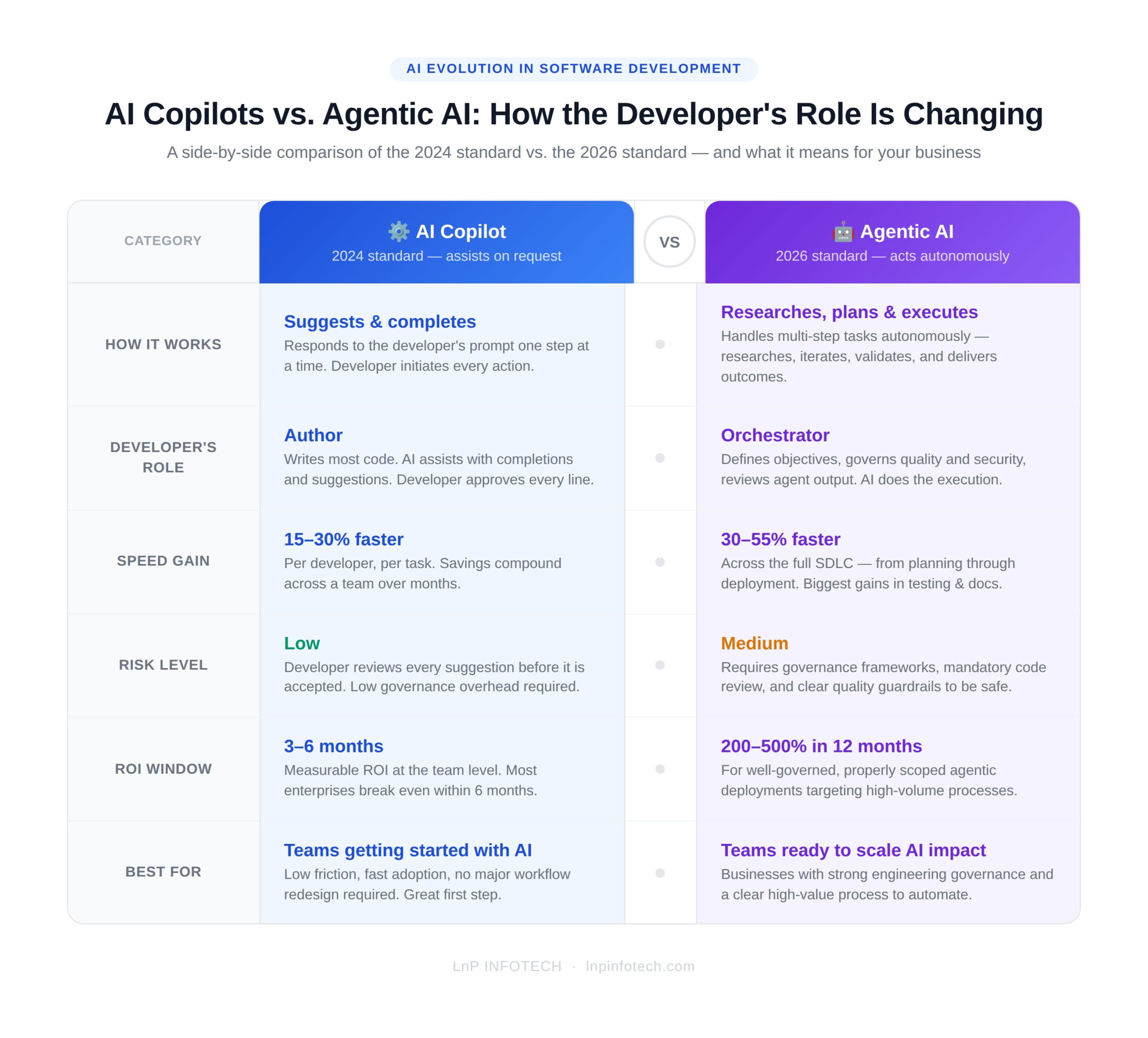
The shift from AI copilots to AI agents represents the most significant change in software development workflows since the move to cloud infrastructure. In 2024, the industry was dominated by copilots tools that draft, suggest, and assist. In 2026, the standard is shifting to agents: tools that research, act, and iterate without step-by-step human direction.
The result is a fundamentally different speed and cost equation for software delivery.
The Numbers: What AI Actually Delivers?
Before talking ROI, let’s establish the baseline performance data that underpins it.
Productivity Gains
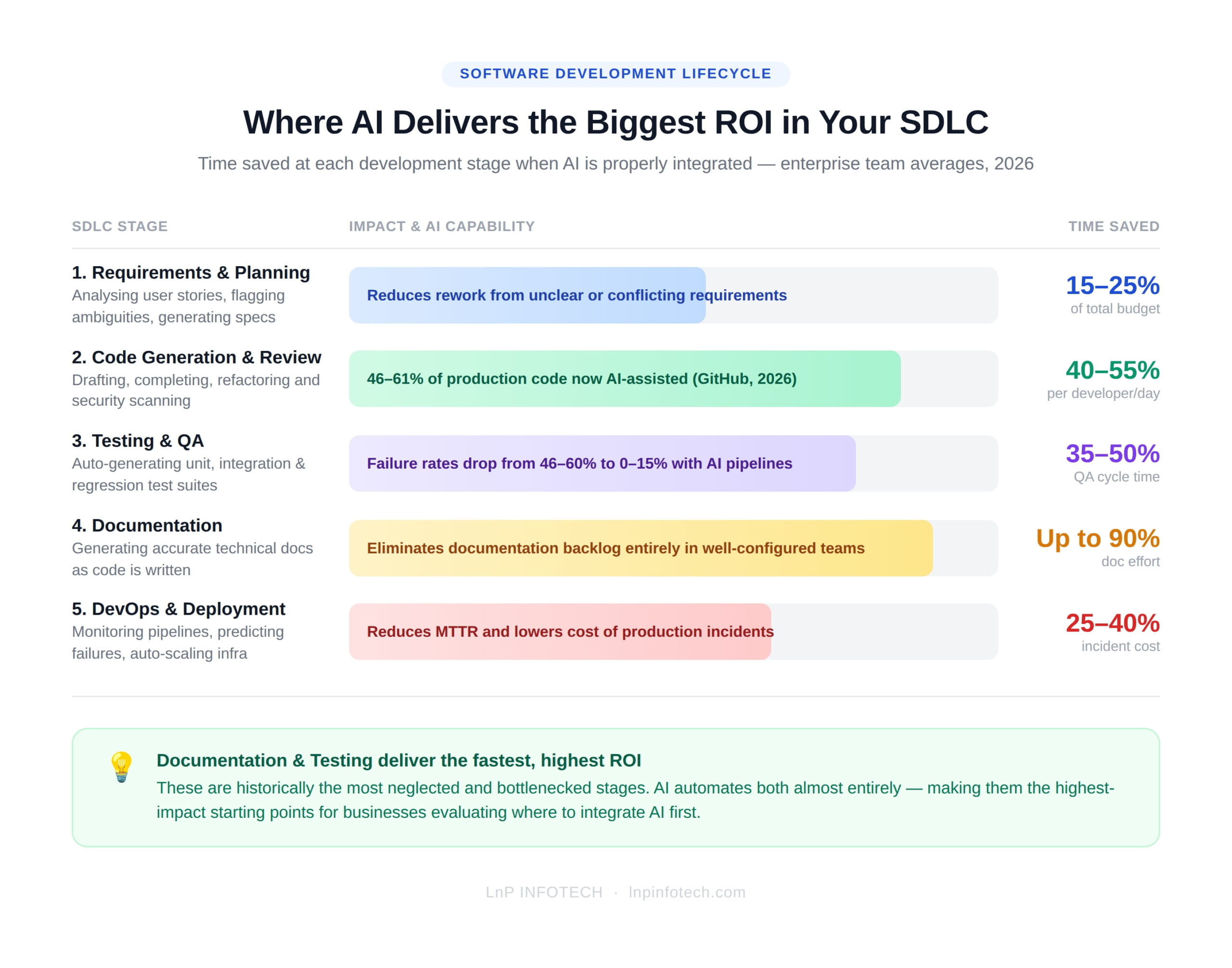
Deloitte’s 2026 Software Industry Outlook projects that AI could drive productivity gains of 30% to 35% across the software development process. That is not a fringe estimate it is a conservative middle-ground figure drawn from thousands of enterprise teams.
Google’s DORA research reports that 90% of software development professionals use AI at work, with teams spending a median of two hours per day working with AI tools meaning AI is already inside planning, coding, documentation, testing, and delivery workflows.
On GitHub, the numbers tell the same story. According to the GitHub Octoverse 2025, developers merged 43 million pull requests per month a 23% increase from the prior year and pushed nearly 1 billion commits, up 25% year-over-year. More output, faster cycles, smaller teams.
Time-to-Market Reduction
Companies that use AI in their product development processes can reduce the time to market by 20–40% and cut development costs by 20–30%.
That is the average. Teams that go further redesigning their full SDLC around AI rather than bolting tools onto existing workflows see even bigger gains. Companies that combine AI-augmented software development with strong engineering practices and code automation are consistently delivering software faster while maintaining quality and scalability.
The ROI Window
Well-defined AI projects often deliver 200–500% returns within 12 months by automating high-volume business processes. According to the Deloitte 2026 State of AI in the Enterprise, most enterprises report measurable ROI within 3–6 months of deployment.
These are not aspirational projections. They reflect what businesses are actually experiencing when AI is implemented with clear objectives, clean data, and proper governance.
Where AI Delivers the Biggest ROI in the SDLC?
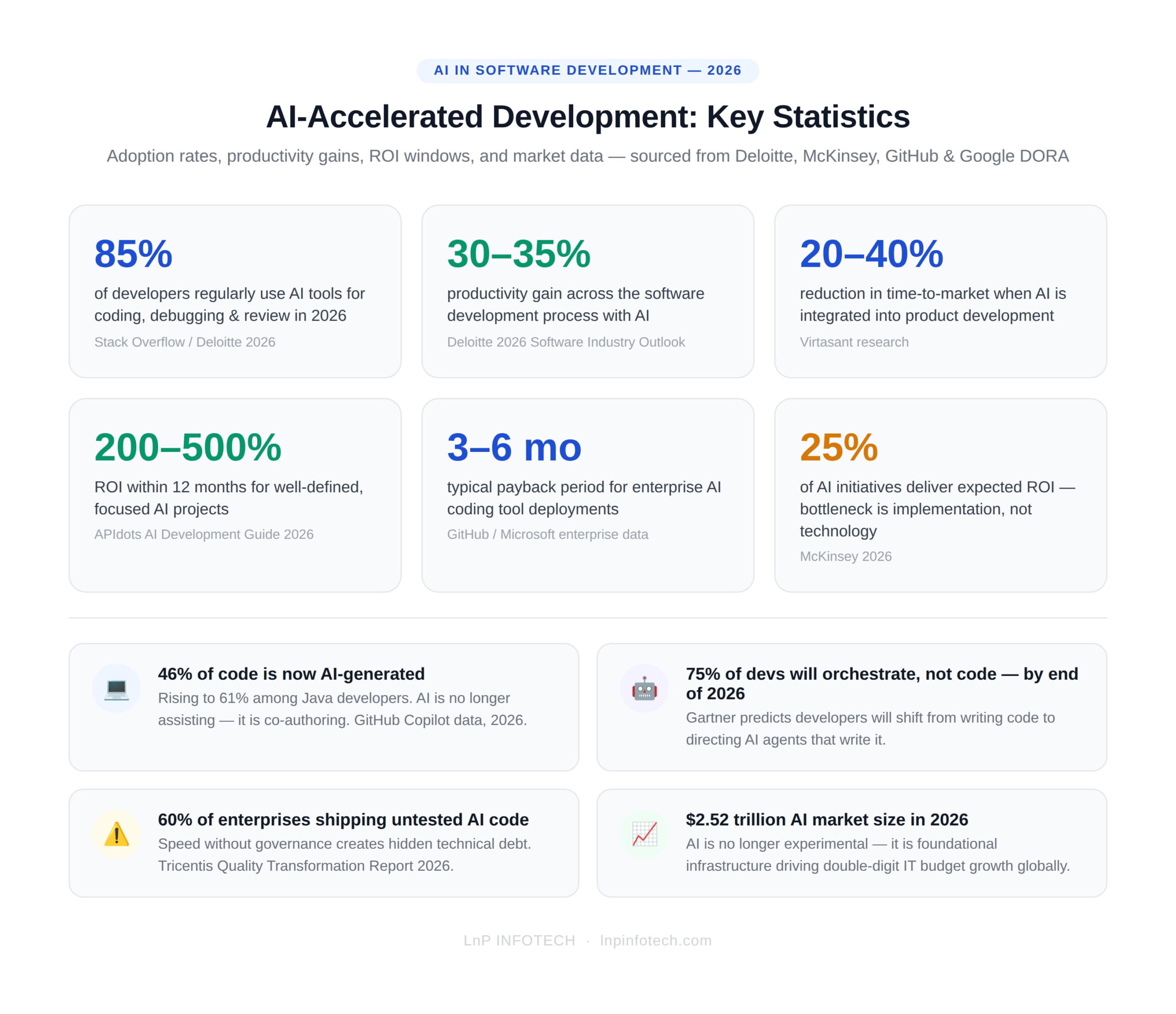
Not every part of software development benefits equally from AI. The highest returns come from specific, well-defined phases.
1. Requirements & Planning
AI tools can now analyze user stories, flag ambiguities, identify conflicts between requirements, and generate detailed technical specifications work that previously consumed days of senior engineering time. Reducing rework caused by unclear requirements alone can save 15–25% of total project budget.
2. Code Generation & Review
This is where AI has made the most visible impact. GitHub Copilot, Claude, and similar tools can generate working code from natural language prompts, complete functions, suggest refactors, and flag security issues in real time. GitHub’s Octoverse data shows that 46% of code is now built using AI tools across all languages, rising to about 61% among Java developers.
The time savings per developer per day add up fast. Even a conservative 90-minute saving per developer per day, across a team of 10, equals 150 hours recovered per month time that goes directly back into shipping features.
3. Testing & QA
Automated test generation is arguably the area where AI delivers the most underappreciated ROI. Traditional QA is slow, expensive, and often a release bottleneck. AI can write unit tests, integration tests, and regression suites directly from the codebase without a human scripting each one.
Companies already using AI-driven pipelines see failure rates drop to the 0–15% range. Low performers sit at 46% to 60% a three- to fourfold difference in stability. Fewer production bugs means fewer emergency patches, fewer support tickets, and less reputational damage.
4. Documentation
Technical documentation is one of the most consistently neglected parts of software development not because teams don’t value it, but because it is time-consuming and often deprioritized under deadline pressure. AI generates accurate, context-aware documentation as code is written, eliminating the documentation backlog entirely in well-configured teams.
5. DevOps & Deployment
AI-powered DevOps tools monitor pipelines, predict deployment failures before they happen, auto-scale infrastructure based on traffic patterns, and flag anomalies in production logs. For teams running continuous deployment pipelines, this reduces mean time to recovery (MTTR) and dramatically lowers the cost of incidents.
Real Business Impact: What This Looks Like in Practice?
Legacy Modernization
In an AI-accelerated COBOL-to-Spring-Batch modernization, agentic AI tools compressed the discovery, analysis, and documentation phases that have historically made legacy migration prohibitively expensive with manual development effort dropping by approximately 20 to 30%, with strict validation of business logic preserved throughout.
Legacy modernization projects have historically been budget killers. AI does not eliminate the complexity, but it makes the most expensive phases discovery, documentation, and refactoring dramatically faster.
Healthcare Administration
A mid-market healthcare administration firm faced a critical bottleneck: prior authorization requests averaged 4.2 days each, frustrating clinicians and delaying patient care. After deploying AI-powered workflow automation across their request processing pipeline, turnaround dropped to under 24 hours a 5× improvement that directly impacted patient outcomes and operating costs.
Manufacturing & Process Industries
AI reduced the time required for officer competency assessments at a manufacturing firm by 75%, cutting a 10-week manual process down to a fraction of the time generating significant cost savings and over 280 hours of productivity gains within the first phase of implementation.
Product Companies & SaaS
For software product companies, AI-accelerated development changes the competitive equation entirely. A team of 5 developers using AI-augmented workflows can ship what previously required a team of 12. Startups can now compete with enterprise engineering teams on feature velocity. Established companies can shrink release cycles from quarters to weeks.
The Risks: Where AI-Accelerated Development Goes Wrong?
Here’s the thing most vendors won’t tell you: the ROI case is real, but it isn’t guaranteed. A lot of businesses are spending on AI tools and seeing very little in return. Not because the technology doesn’t work but because of how they’re using it.
These are the mistakes we see most often.
Shipping code nobody checked
60% of enterprises are now shipping untested AI-generated code, according to Tricentis’ Quality Transformation Report. That’s a staggering number. AI can write code fast but fast and correct are not the same thing. Without proper review, security scanning, and QA, you’re not accelerating development. You’re accelerating the path to a production incident.
Speed is only an advantage if what you’re shipping actually works.
Trusting the output too much or not at all
Here’s an interesting tension: 84% of developers use or plan to use AI tools, but only 29% actually trust what it produces. That number has dropped from 40% in 2024. So adoption is climbing while trust is falling. Teams that rubber-stamp AI output without review are sitting on a growing pile of hidden quality risk. Teams that distrust it so much they second-guess every line aren’t getting the speed benefits either. The sweet spot is in the middle treat AI output as a strong first draft, not a finished product.
Trying to AI your way out of a messy foundation
Only 5.5% of organizations capture meaningful enterprise-level value from AI, according to McKinsey’s AI research. The rest? They deployed AI before their data, systems, or architecture were ready for it.
AI doesn’t fix fragmented systems. It moves faster through them which usually makes the mess worse. If your data is siloed, your APIs are inconsistent, and your legacy stack hasn’t been touched in years, no AI tool is going to change that. It’ll just surface the problems more quickly and more expensively.
Boiling the ocean
Only 25% of AI initiatives deliver expected ROI. The primary reason isn’t the technology it’s the scope. Businesses try to transform everything at once: every workflow, every team, every process. The result is a sprawling initiative with no clear owner, no measurable outcomes, and a budget that quietly disappears.
Start with one process. One team. One clearly defined problem. Prove the ROI there, then expand.
The Agentic Shift: What Changes in 2026 and Beyond?
If you think AI coding assistants are impressive now, you haven’t seen where this is heading.
The copilot era where AI suggests code and a developer decides what to keep is already giving way to something fundamentally different. Agentic AI doesn’t wait to be prompted. It takes a goal, breaks it into tasks, executes across multiple steps, checks its own work, and delivers an outcome. The developer’s job shifts from writing code to directing the agent, reviewing the output, and making sure nothing slips through the guardrails.
Gartner puts it bluntly: by the end of 2026, 75% of developers will orchestrate rather than code.
That’s not a small shift. That’s a complete redefinition of what a developer does on a daily basis. And for businesses, it changes the ROI question entirely. It’s no longer “how much faster can our team code?” It’s “how much of our delivery pipeline can we safely hand to an AI agent and what does the governance around that look like?”
The businesses figuring that out right now will have a 12–18 month head start on the ones that wait.
How to Calculate ROI on AI-Accelerated Development for Your Business?
Before investing, run this simple framework:
Step 1 – Establish your baseline costs What does your current development process cost? Include developer salaries, QA time, deployment overhead, support costs for production bugs, and time spent on documentation and rework.
Step 2 – Identify your highest-friction stages Where do projects stall? Where does rework happen most? Where do bugs escape into production? These are your highest-ROI targets for AI integration.
Step 3 – Apply conservative productivity estimates Use 20–30% productivity improvement as your baseline (the lower end of what independent research consistently shows). Apply that to your current cost figures to model savings.
Step 4 – Model time-to-market impact For every week you cut from a release cycle, what is the business value? Earlier customer feedback, earlier revenue, earlier competitive advantage. This number is often larger than the direct cost savings.
Step 5 – Factor in implementation costs Tooling, integration work, training, and governance setup are real costs. A proper AI-accelerated development programme requires upfront investment to set the right foundations.
Step 6 – Calculate payback period Most well-scoped implementations break even within 3–6 months. Conservative estimates that use only the productivity savings (ignoring time-to-market value) typically show payback within 9–12 months.
What to Look for in an AI-Accelerated Development Partner?
Not every software development firm has genuinely integrated AI into their delivery model. Many have bolted a tool onto their existing process and called it AI-accelerated. Here is how to tell the difference:
- They can show you where AI is used in their SDLC: not just in coding, but in planning, testing, documentation, and deployment.
- They talk about governance: code review requirements for AI-generated output, security scanning, and quality validation. Speed without governance is a warning sign.
- They have case studies with specific metrics: not just “we used AI,” but “we reduced delivery time by X% and here is what that meant for the client.”
- They scope before they start: the most impactful AI integrations are focused on specific, high-friction stages of your process, not a blanket “we’ll AI everything.”
- They can advise on your data readiness: AI works on clean, connected data. A good software partner assesses your foundations before recommending tools.
Is AI-Accelerated Development Right for Your Business Right Now?
The honest answer: it depends on where you are in your software journey.
AI-accelerated development delivers the strongest ROI when:
- You have a clear, well-scoped software project with defined requirements
- Your team is ready to adopt new workflows and tooling
- Your data and systems are reasonably clean and connected
- You have engineering leadership that can govern AI output effectively
- You are under competitive pressure to ship faster without inflating headcount
It delivers weaker ROI when:
- Requirements are unclear or constantly changing
- Your technical foundation is fragmented or outdated (fix that first)
- You are trying to transform everything at once rather than starting focused
- There is no governance model for AI-generated code
The good news: even businesses that are not fully ready can take focused first steps identifying one high-friction process, integrating AI into that workflow specifically, measuring the result, and expanding from there.
The Competitive Reality
Tasks that once required months can now be completed in a matter of weeks, giving smaller teams and startups a powerful advantage.
That advantage is real but it compounds over time. Businesses that integrate AI into their development process today will have 12–24 months of practice, governance, and institutional knowledge by the time their competitors start. Businesses that wait will be playing catch-up on a moving target.
According to the Stack Overflow 2025 Developer Survey, more than 75% of companies are now putting money into AI for software development not as an experiment, but as a competitive imperative. The question is no longer whether to adopt AI-accelerated development. It is whether you can afford to wait.
Frequently Asked Questions
How long does it take to see ROI from AI-accelerated development?
Most well-scoped implementations show measurable results within 3–6 months. Full ROI payback, accounting for implementation costs, typically occurs within 6–12 months for focused integrations.
Will AI-accelerated development replace developers?
No, but it is changing what developers spend their time on. Developers who design AI-augmented systems and govern AI output are becoming more valuable, not less. Routine coding tasks are being automated; engineering judgment, architecture, and quality oversight are not.
What size business benefits most from AI-accelerated development?
All sizes benefit, but the mechanics differ. Startups gain the ability to compete with larger engineering teams on output. Mid-market companies gain the ability to shrink release cycles without expanding headcount. Enterprises gain the ability to modernise legacy systems and accelerate large, complex programmes.
Do I need to rebuild my systems to use AI in development?
Not necessarily. The most practical approach is to start with focused integrations specific tools in specific stages of your SDLC rather than trying to transform everything at once. Clean data and connected systems improve outcomes, but they are not a prerequisite for getting started.
What is the difference between an AI copilot and an AI agent?
A copilot assists it suggests, completes, and drafts. A developer still initiates and approves every action. An agent acts it researches, executes, iterates, and validates across multi-step tasks, checking in with a human only at key decision points. Agentic systems are where the largest productivity gains are emerging in 2026.
Ready to Build Faster Without Scaling Your Team?
At LnP Infotech, we build custom software using AI-accelerated development practices not as a marketing claim, but as an integrated part of how we plan, code, test, and deliver every project.
Whether you need to modernise a legacy system, build a new product from scratch, or integrate AI into an existing platform, we combine experienced engineering judgment with AI tooling to deliver faster, more reliably, and at lower cost than traditional development approaches.
Here’s what working with LnP Infotech looks like:
- ✅ AI integrated across your SDLC not just code generation, but testing, documentation, and DevOps
- ✅ Governance built in all AI-generated output reviewed, validated, and security-scanned
- ✅ Focused scoping we identify your highest-ROI integration points before we start
- ✅ Clear metrics we define success criteria upfront and report against them
- ✅ Domain expertise across PropTech, healthcare, finance, and enterprise software
- ✅ Transparent delivery no black boxes, no scope surprises
Stop leaving development speed and cost savings on the table. Let’s talk about what AI-accelerated development could mean for your next project.
👉 Get a Free Consultation with LnP Infotech No commitment, just clarity.