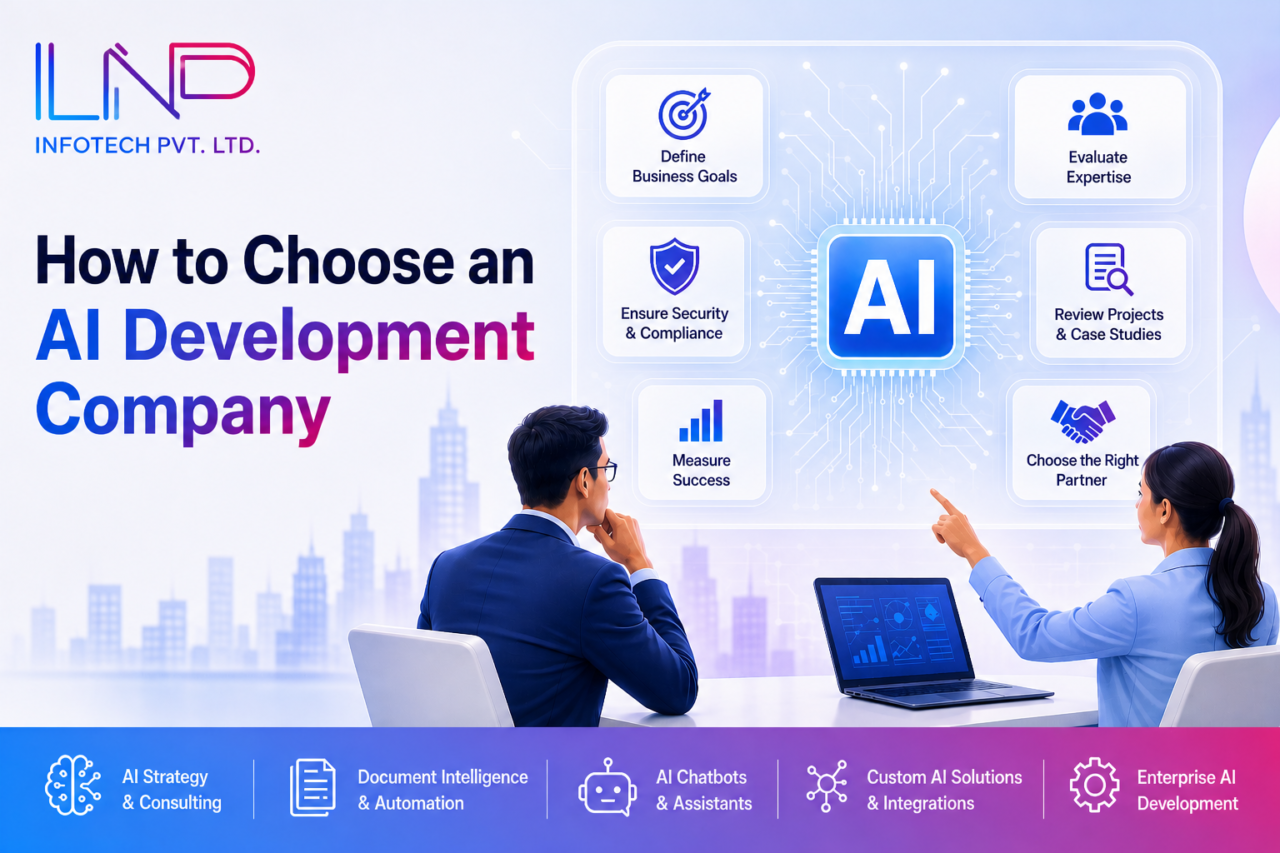
Choosing an AI development company is not just about finding a team that understands artificial intelligence. It is about finding a technology partner that can understand your business, identify the right use case, build a reliable solution, and integrate it into your existing operations.
Whether you want to develop an AI-powered application, automate document processing, build an intelligent chatbot, or integrate AI into an existing software product, the development partner you choose can significantly influence the project’s cost, performance, security, and long-term value.
The stakes are real. A February 2026 Dataiku and Harris Poll study found that 74% of surveyed CIOs regretted at least one major AI vendor or platform selection made in the previous 18 months. The survey included 600 CIOs worldwide. This finding highlights why vendor evaluation should go beyond sales presentations and impressive demonstrations.
For businesses considering AI adoption, the goal is to find an experienced AI development company that combines technical expertise with practical business understanding.
In this guide, we will explain how to evaluate AI development partners, compare proposals, assess security and pricing, identify red flags, and make a confident hiring decision.
Why Choosing the Right AI Development Partner Matters
AI can help businesses automate repetitive work, extract information from documents, improve customer support, analyze large datasets, and create more personalized digital experiences. However, successful implementation requires much more than connecting an application to an AI model.
A solution must work with real business data, follow existing workflows, protect sensitive information, and produce results that can be measured.
For example, imagine a financial services company that processes thousands of loan agreements. A generic AI chatbot would not solve its main problem. The business needs a document-processing workflow that can extract specific fields, validate the output, identify exceptions, and store the results in a structured system.
That difference is what separates a simple AI demonstration from a practical business solution.
A capable development partner should help you answer three questions before development begins:
- Is AI the right solution? Could conventional software or workflow automation solve the problem more reliably or economically?
- Can the solution work in your environment? Does it integrate with your databases, applications, APIs, and business processes?
- How will success be measured? Will the project reduce processing time, improve accuracy, lower operating costs, or increase conversions?
The right partner focuses on these business outcomes rather than recommending AI simply because it is popular.
1. Define Your Business Goals Before Contacting AI Companies
Before comparing vendors, be clear about the problem you want to solve. You do not need a complete technical specification, but you should be able to explain what is not working today and what a better outcome would look like.
Start by identifying:
- The business problem you want to address.
- The people who will use the solution.
- The data and software systems involved.
- The expected business outcome.
- Any budget, security, or delivery constraints.
Consider these examples:
| Business challenge | Potential AI solution | How to measure success |
|---|---|---|
| Employees spend hours reviewing documents | AI document processing and data extraction | Processing time, extraction accuracy, manual review rate |
| Customer support receives repetitive queries | AI chatbot or virtual assistant | Resolution rate, response time, customer satisfaction |
| Employees struggle to find information across internal documents | Semantic search or a retrieval-augmented generation (RAG) system | Search relevance, time to find information |
| Managers prepare reports manually | AI-assisted reporting and workflow automation | Reporting time, data consistency, error rate |
| An existing application needs intelligent features | AI integration into the current software | Feature adoption, task completion, operational impact |
These are possible solutions, not recommendations that apply to every business. The right approach depends on your data quality, existing systems, risk tolerance, and requirements.
For example, if your main problem is moving data between two systems, a conventional API integration may be more reliable and less expensive than an AI agent. A good development partner should be willing to explain that distinction.
If your requirements involve a broader digital product, explore custom software development services alongside AI-specific solutions. This helps ensure that the complete application, rather than just the AI component, is designed around your business needs.
2. Evaluate the Company’s AI Development Expertise
Not every software development company has the experience required to build and maintain production-ready AI solutions. Similarly, a company that specializes in AI research may not have the engineering resources needed to integrate a solution into your existing business applications.
Look for a partner that understands both AI capabilities and the software engineering required to use them effectively.
Check for experience with relevant AI technologies
Depending on your use case, the company may need experience with:
- Large language models (LLMs) and generative AI.
- AI chatbots and conversational assistants.
- Retrieval-augmented generation (RAG) and semantic search.
- Optical character recognition (OCR) and document intelligence.
- Machine learning, prediction, classification, and recommendation systems.
- AI agents and workflow automation.
- API integration, cloud infrastructure, databases, and application development.
You do not need every technology in every project. Ask the vendor to explain which tools are appropriate for your requirements and why.
For example, a company building a document-processing system should be able to explain how it handles scanned PDFs, inconsistent layouts, missing values, structured output, validation, and failed processing jobs not just how it sends a document to an LLM.
Look for full-cycle development capabilities
An AI feature rarely operates in isolation. It may require a user interface, backend services, authentication, a database, third-party APIs, cloud deployment, and ongoing maintenance.
A company offering custom software development and mobile app development alongside AI engineering may be a better fit when you need a complete application or want to add AI to an existing product.
Ask prospective partners whether they can handle the entire delivery lifecycle or whether you will need separate vendors for architecture, integration, testing, deployment, and support.
3. Review Real AI Projects and Case Studies
A portfolio is useful, but the quality of the evidence matters more than the number of projects displayed.
Ask the company to show you a project that resembles your own in terms of business problem, data complexity, integration requirements, or operating environment.
For each case study, look for:
- The original business challenge.
- Why AI was selected over alternative approaches.
- The solution architecture and technologies involved.
- How output quality was measured and validated.
- How the solution integrated with existing systems.
- What changed after deployment.
- Any limitations, risks, or lessons learned.
Be cautious when a vendor shares only polished demos or claims impressive accuracy without explaining how it was measured.
A real-world example from LNP Infotech
LNP Infotech has published a case study, Automated Legal Document Validation at Scale with AI, describing a production workflow developed for an operations and compliance use case.
The system processes home-equity loan agreements and extracts approximately 100 structured fields from each agreement. According to the published case study, the workflow handles a few hundred agreements every ten minutes across ten parallel workers.
The engineering is not limited to extracting information with an AI model. It also includes duplicate-processing safeguards, structured output, database storage, error handling, and alerts when processing fails.
Why is this relevant when choosing an AI development company? Because the business value comes from the complete workflow not just the model’s ability to read a document.
This is the type of evidence worth looking for when evaluating any vendor: a clearly defined problem, a functioning solution, specific technical safeguards, and measurable operational output.
4. Assess Data Security, Privacy, and AI Governance
Security should be discussed before a vendor receives access to your business data not after development has started.
AI applications may process customer records, financial documents, employee information, internal business knowledge, or other confidential material. You need to understand where that data goes, how it is stored, who can access it, and whether any third-party AI provider processes it.
Ask the company:
- Will our data be sent to an external AI provider?
- Will our data be used to train or improve a third-party model?
- How are data access, encryption, retention, and deletion managed?
- Can the solution operate within our approved cloud or infrastructure environment?
- How are AI outputs logged, tested, and reviewed?
- What happens if the model generates an incorrect or unsafe response?
Your answers will depend on the type of data and the regulatory requirements of your industry.
Two useful references for evaluating a vendor’s approach are:
- The NIST AI Risk Management Framework, which provides voluntary guidance for managing AI risks and incorporating trustworthiness into the design, development, deployment, and evaluation of AI systems.
- ISO/IEC 42001:2023, an international standard for establishing and improving an AI management system.
These references can help structure discussions about risk and governance. They are not proof that a particular vendor is compliant or certified. Verify any certification claims directly.
Also ask how the company handles inaccurate outputs. In a low-risk brainstorming tool, an occasional incorrect suggestion may be manageable. In financial document processing, healthcare, or compliance workflows, the same error may have much more serious consequences.
A responsible AI development company should define appropriate validation, human review, escalation, and monitoring procedures based on the risks of the application.
5. Understand the Development Process and Project Timeline
A professional AI development company should have a clear process for moving from an initial idea to a working, tested solution.
While the exact workflow varies by project, a typical engagement includes the following stages.
How long does AI development take?
There is no reliable timeline that applies to every AI project. A small chatbot using an existing knowledge base has very different requirements from a custom machine learning system that processes sensitive documents and integrates with several enterprise applications.
The timeline depends on data readiness, integration complexity, the number of features, testing requirements, and the consequences of an incorrect output.
Ask the vendor for a milestone-based estimate that identifies dependencies, client responsibilities, testing time, and potential risks. A small proof of concept may help validate feasibility before you commit to a larger implementation.
6. Compare AI Development Costs and Engagement Models
The cheapest proposal is not always the most economical choice. Two companies may quote different amounts because they have different assumptions about scope, testing, integrations, infrastructure, and post-launch support.
Instead of comparing only the total price, ask each company to explain what is included.
What affects AI development costs?
| Cost factor | Why it matters |
|---|---|
| Project complexity | A basic API integration differs from a multi-step AI workflow or custom model. |
| Data preparation | Data cleaning, labeling, document processing, and access permissions may require significant effort. |
| Integration requirements | Connecting AI to existing software, databases, and third-party systems adds work. |
| Model and infrastructure usage | API consumption, cloud hosting, storage, and monitoring can create recurring costs. |
| Testing and governance | Evaluation datasets, security reviews, human approval, and compliance requirements affect scope. |
| Maintenance | Model changes, software updates, monitoring, and ongoing improvements require resources. |
Which engagement model should you choose?
| Model | Best suited for | Consideration |
|---|---|---|
| Fixed-price project | Clearly defined scope and deliverables | Changes may require revised estimates. |
| Time and materials | Evolving requirements and iterative development | Requires regular budget and scope reviews. |
| Dedicated development team | Long-term development or continuous product improvement | Requires ongoing coordination and prioritization. |
| Proof of concept | Testing technical feasibility before full investment | The prototype may need additional work before production use. |
A dedicated software development team can be useful when AI is part of a larger product roadmap and you expect to continue adding features after the first release.
Before signing a contract, confirm who owns the code and project-specific assets, how third-party subscriptions are billed, what support is included, and what happens if the project scope changes.
7. Check Communication, Team Quality, and Long-Term Support
Even technically capable developers can struggle to deliver a successful project if communication is poor or responsibilities are unclear.
During the selection process, find out who will manage your project, who will make architecture decisions, and which engineers will actually build the solution.
Ask prospective vendors:
- Who will be our primary point of contact?
- Will we have direct access to the technical team?
- How frequently will we receive progress updates and working demonstrations?
- How will changes to requirements be handled?
- What testing and code-review procedures are followed?
- What support is available after deployment?
Look for a company that communicates technical trade-offs in plain language and flags problems early rather than waiting until a deadline is missed.
Post-launch support also deserves attention. AI applications can behave differently when data changes, usage increases, external APIs are updated, or a model provider changes its service. Establish responsibility for monitoring, incident response, updates, and ongoing evaluation before development begins.
8. Watch for These Red Flags When Hiring an AI Development Company
A few warning signs can help you eliminate unsuitable vendors before investing in lengthy discussions.
One important point: a credible company should be comfortable discussing limitations. If a vendor explains that your data needs improvement or that a proposed AI feature requires human review, that may indicate a more realistic engineering approach not a lack of confidence.
9. Use This Checklist Before Making Your Final Decision
Before choosing an AI development company, review each shortlisted vendor against the following criteria.
Use the same checklist for every vendor so that you compare them on consistent criteria rather than relying on presentations or price alone.
10
- Understands our business problem and desired outcomes
- Has relevant AI and software engineering experience
- Can demonstrate comparable projects or technical proof
- Explains data security, privacy, and governance
- Provides a clear architecture and integration plan
- Defines measurable acceptance criteria
- Offers transparent pricing and delivery milestones
- Clarifies code ownership and contract terms
- Includes testing, deployment, and post-launch support
- Communicates clearly and identifies project risks
Why Consider LNP Infotech for Your AI Development Project?
LNP Infotech works across AI-powered solutions and broader software engineering, including custom applications, mobile apps, cloud-based systems, automation, and software modernization.
Our AI software development services cover AI-powered applications, chatbots and assistants, document intelligence, semantic search, custom AI agents, enterprise AI integration, and machine learning solutions.
We also bring broader engineering capabilities into the discussion. Depending on your project, that can include custom software development, mobile app development, and dedicated AI development teams.
The aim is to identify the right approach for your requirements, integrate it into the wider software environment, and establish a clear plan for testing and delivery.
If you are evaluating AI for a specific business challenge, start with the problem, the data you have, and the outcome you want to achieve.
Planning an AI project? Request a project consultation with LNP Infotech to discuss your requirements and potential next steps.
Frequently Asked Questions
1. How do I choose the best AI development company?
Evaluate the company’s relevant technical experience, project evidence, security practices, integration capabilities, communication, pricing transparency, and post-launch support. The best fit is the company that understands your business problem and can demonstrate a realistic approach to solving it.
2. How much does it cost to hire an AI development company?
The cost depends on the use case, project scope, data preparation, model usage, integrations, infrastructure, and testing requirements. Request an itemized proposal that distinguishes initial development costs from ongoing operating and maintenance expenses.
3. How long does it take to develop an AI solution?
A small proof of concept may take considerably less time than a production-grade application. The timeline depends on data readiness, integrations, security requirements, complexity, and validation. Ask for a phased estimate with clear milestones.
4. Should I choose an AI specialist or a full-service software development company?
An AI specialist may be appropriate for research-heavy or highly specialized model development. A full-service software company with demonstrated AI expertise can be a strong fit when you also need application development, APIs, databases, user interfaces, cloud deployment, and ongoing maintenance.
5. What questions should I ask an AI development company before hiring?
Ask about comparable projects, technology choices, data handling, model evaluation, integration, ownership of deliverables, delivery milestones, ongoing costs, and support. Request evidence for important claims and agree on measurable acceptance criteria.
6. How can I ensure an AI solution is secure and reliable?
Discuss data access, encryption, retention, third-party model providers, output validation, monitoring, and human review. Select controls based on the application’s risk level and applicable regulatory requirements, and test the solution before production deployment.
7. Can AI be integrated into existing business software?
Yes. AI capabilities can often be integrated into existing web applications, mobile apps, enterprise platforms, and internal workflows through APIs and supporting services. Feasibility depends on the current architecture, available data, security requirements, and integration constraints.