Category: Software Development | Reading Time: 13 min
Something shifted in the conversation about Indian software development around 2023. The question stopped being “should we consider India?” and became “which Indian partner is right for us?”
That shift reflects a change in how global businesses think about offshore development. For most of the 2000s and 2010s, India was the cost play. You went there to save money. Quality was a secondary concern something you managed carefully and accepted trade-offs on.
That framing is outdated. In 2026, India handles 55% of global IT outsourcing demand. More than 500 global companies from Series A startups to Fortune 500 enterprises name India as their primary software development destination. According to NASSCOM, India’s IT and software exports crossed $194 billion in FY2024-25, serving clients in over 80 countries. And according to Deloitte’s Global Outsourcing Survey, over 70% of US companies use offshore development to improve speed to market and access specialized skills not just to reduce costs.
Cost is still part of the story. But it’s no longer the whole story and businesses that approach India purely as a cost lever consistently get worse results than those that approach it as a strategic capability decision.
This article breaks down the real reasons global businesses are choosing India for software development in 2026 what’s changed, what’s still true, and what to watch out for when choosing your partner.
1. The Talent Pool Is Simply Unmatched
India produces 2.5 million STEM graduates annually. The active software developer workforce reached 5.82 million in 2026 the second largest in the world, behind only the United States, and growing faster. By some projections, India will have the largest developer population globally within three to four years.
The depth matters as much as the size. India has meaningful concentration in every major technology category: cloud architecture, .NET and Java enterprise development, React and modern frontend frameworks, AI and machine learning, DevOps and QA, mobile development, and cybersecurity. Developers working in Noida, Bengaluru, and Hyderabad routinely collaborate with engineering teams at Google, Amazon, Microsoft, and Adobe which sets the quality benchmark by global standards, not local ones.
This wasn’t always true. First-generation offshore development in the early 2000s involved genuine quality trade-offs. Twenty-plus years of serving international clients across every major industry has changed the talent profile significantly. The senior engineers at India’s best software firms have built production systems for companies you know and they have the scars to prove it.
For businesses in specialized sectors healthcare software, PropTech, financial services technology domain expertise within the Indian development market has deepened considerably. You can find firms with genuine vertical depth, not just general engineering capability.
2. The Cost Advantage Is Real But Not What Most Buyers Think
The headline number is 60–80% cost savings versus US or UK rates for equivalent seniority. That’s real. A senior developer at a reputable Indian firm costs $35–$55 per hour. The equivalent in the US is $100–$200 per hour. For a team of eight engineers over twelve months, the arithmetic is straightforward.
But the headline number is also misleading in two ways that matter.
First, the realistic saving after accounting for overhead time zone management, communication coordination, the occasional need for onshore involvement in stakeholder-facing work is closer to 55–62%. Still the best cost lever available to most software businesses, but plan for the real figure rather than the brochure one.
Second, the cost advantage compounds most powerfully when the engagement is structured correctly. A business that treats its Indian partner as a feature factory throwing tickets over the wall and expecting finished software back consistently gets worse outcomes, at higher effective cost, than one that builds a genuine working relationship with shared context and direct communication. The structure of the engagement matters as much as the hourly rate.
Here’s a realistic cost comparison for common project types:
| Project type | US / UK agency | India specialist firm | Effective saving |
|---|---|---|---|
| SaaS MVP | $80,000–$160,000 | $25,000–$60,000 | 60–70% |
| Mid-market web platform | $150,000–$300,000 | $50,000–$120,000 | 60–67% |
| Healthcare software (HIPAA) | $200,000–$400,000 | $70,000–$150,000 | 62–65% |
| Enterprise .NET application | $200,000–$400,000 | $60,000–$150,000 | 62–70% |
| Legacy modernization | $200,000–$500,000 | $60,000–$200,000 | 60–70% |
3. The Time Zone Advantage Is Underrated
Most conversations about India and time zones focus on the challenge the 5.5 to 13.5 hour gap from Western markets. But for businesses that structure their engagement correctly, the time zone difference is actually an advantage.
An Indian development team that works a standard day in IST delivers a full day of output while their US or UK counterparts are asleep. When the US team starts their morning, there’s a completed sprint’s worth of work to review. Feedback goes back during the US working day, the Indian team incorporates it overnight, and the cycle runs again. Effectively, the development clock runs 24 hours a day not because anyone is working through the night, but because the working days are sequenced to enable it.
This follow-the-sun model is one of the core reasons that well-structured India outsourcing partnerships consistently deliver faster time-to-market than purely onshore teams. It’s not automatic it requires intentional process design but businesses that get it right regularly report development cycles 20–35% shorter than their onshore equivalents.
4. English Proficiency and Communication Standards Have Changed
This was a genuine objection ten years ago. It’s less valid in 2026.
India has one of the largest English-speaking populations in the world, with English widely used as the primary professional language across the Indian tech industry. Technical communication requirements gathering, architectural discussion, sprint reviews, stakeholder updates is conducted fluently in English at every reputable Indian development firm. Many have been doing it with US and UK clients for 15–20 years.
What has changed most is the process sophistication around communication. The better Indian firms now operate on Agile or hybrid delivery models with structured communication cadences daily standups, weekly sprint reviews, dedicated Slack channels, documented handoff protocols that were not standard practice in the early outsourcing era.
The communication failures that gave offshore development a bad reputation in the 2000s were often as much about poor client-side process design as they were about the development firm. A client that drops a vague requirements document and disappears for a month will get poor results from any development partner, onshore or off.
5. Global Capability Centre’s Have Normalized the Model
One of the strongest signals that India’s software development market has matured is the scale of Global Capability Centre (GCC) growth. According to NASSCOM’s GCC report, India hosts 1,700+ GCCs employing 1.9 million professionals engineering center’s set up by major international corporations to run their software development from India as an in-house function rather than an outsourced one.
The GCC list includes Google, Microsoft, Goldman Sachs, Morgan Stanley, Amazon, Walmart, Boeing, and hundreds of others. These are not back-office support operations. They are engineering center’s building mission-critical software for global deployments.
This matters for smaller businesses evaluating India as a development destination for two reasons. First, it validates the quality of engineering available. If Goldman Sachs runs quantitative modelling systems from Bengaluru and Boeing runs avionics software from Hyderabad, the engineering talent question is settled. Second, it has raised the bar for the broader market the firms that supply talent to GCCs have had to compete on engineering quality, which has raised standards across the ecosystem.
6. AI Integration Has Changed the Delivery Speed Equation
In 2026, the firms delivering the fastest, most cost-effective software development in India are not just benefiting from lower labour costs. They’re running AI-accelerated development workflows that compress build cycles dramatically.
Firms using AI Codex, agentic development tools, and automated testing across their delivery model are producing working software in timelines that would have been considered unrealistic 18 months ago. A product that would have taken a conventional team 5 months can take an AI-accelerated team 6–8 weeks. The hourly rate may be similar; the total hours are not.
This changes the buyer question in 2026. It’s no longer just “can I get this built cheaper in India?” It’s “can I get this built cheaper and faster in India?” For businesses evaluating partners, asking specifically how AI is integrated into the development process not whether the firm mentions AI, but how it’s used at which stages with what governance is now one of the most important qualification questions.
The firms that have genuinely integrated AI into their delivery model can answer this question in detail. Those that haven’t will give you a vague answer about “leveraging AI capabilities.”
7. The Regulatory and IP Framework Is Mature
Intellectual property protection was a legitimate concern for early-stage offshore outsourcing. It remains worth managing carefully but the legal and contractual frameworks have matured significantly.
India’s IT Act and contractual enforcement mechanisms have strengthened. Standard contracts with Indian development firms now routinely include explicit IP assignment clauses, source code escrow provisions, confidentiality and NDA terms, and non-compete provisions. The legal enforceability of these terms has improved substantially over the past decade.
Reputable Indian development firms are also increasingly ISO 27001 certified for information security management, and many carry SOC 2 compliance or are pursuing it. For regulated industries like healthcare and financial services, this matters it’s no longer a differentiator but an expectation.
The practical advice for businesses entering any India engagement: be explicit about IP ownership in your contract (you own all code and work product on delivery and payment), run an NDA before sharing sensitive information, and verify the firm’s security certifications before sharing access to sensitive systems. Standard due diligence the same you’d apply to any technology vendor.
8. India vs Other Outsourcing Destinations: How the Comparison Lands in 2026
India is not the only offshore development destination. Eastern Europe, Vietnam, the Philippines, Latin America, and others all have genuine engineering talent and competitive rates. Here’s how the comparison sits in 2026:
| Factor | India | Eastern Europe | Vietnam | Latin America |
|---|---|---|---|---|
| Talent pool size | 5.82M developers | ~1.5M | ~550K | ~700K |
| Hourly rate range | $25–$75 | $40–$100 | $20–$50 | $35–$80 |
| English proficiency | High | Medium-high | Medium | Medium-high |
| Time zone (US overlap) | Low (async) | Low (async) | Low (async) | High (real-time) |
| Ecosystem maturity | Very high | High | Medium | Medium |
| GCC presence | Very high | Moderate | Low | Low |
| AI delivery capability | High | Medium | Low-medium | Medium |
Latin America wins on time zone alignment for US businesses that need real-time collaboration. Eastern Europe has strong technical depth and is closer to European clients. Vietnam offers very competitive rates for specific tech stacks.
But on talent pool depth, ecosystem maturity, GCC validation, and track record with enterprise clients, India’s lead is substantial and not easily closed in the near term.
What to Get Right When Choosing an Indian Development Partner?
The decision to work with Indian development partners is straightforward. The decision of which partner is harder, and it’s where most businesses make mistakes.
- Domain expertise matters more than general capability: A firm that has built fifteen healthcare platforms understands HIPAA architecture, clinical workflow logic, and the edge cases that catch first-timers. A generalist firm building its second healthcare product will take longer, make more mistakes, and produce less reliable compliance architecture. For domain-specific builds, vertical depth consistently beats general engineering quality.
- Scoping quality predicts delivery quality: A firm that can’t give you a detailed, well-reasoned project breakdown during the sales process won’t suddenly develop that capability during delivery. The quality of a firm’s discovery and scoping work is the most reliable predictor of their project management quality.
- Ask about team composition specifically: “We have senior engineers” is not an answer. Ask who will work on your project, what their experience level is, and who the lead architect is. Ask to see their profiles. Any firm with confidence in their team will show you.
- Communication structure is not optional: Agree on communication cadence, tools, escalation paths, and sprint review format before the project starts, not after the first miscommunication. The best Indian development firms will have a clear process for this already.
- AI capability is now a baseline question: In 2026, ask specifically how the firm uses AI in their development process. A firm not genuinely using AI-accelerated workflows is leaving speed and cost efficiency on the table which ultimately comes out of your project budget and timeline.
Frequently Asked Questions
Is outsourcing software development to India still a good idea in 2026?
Yes, and the case is stronger than it was five years ago. The talent pool has deepened, AI-accelerated delivery has compressed timelines significantly, and the legal and IP frameworks have matured. India handles 55% of global IT outsourcing demand for a reason. The question in 2026 is not whether India is a good destination but which type of partner is right for your specific project.
How much can a global business actually save by using an Indian development firm?
The realistic saving after accounting for engagement overhead is 55–65% versus comparable US or UK rates. For a $200,000 US project, the equivalent in India typically runs $60,000–$90,000 with a senior-led team. AI-accelerated firms compress this further by reducing the total hours required not just the hourly rate.
What types of software projects are best suited for Indian development firms?
Custom SaaS products, enterprise applications, mobile and web platforms, AI-integrated products, and legacy modernization all have strong track records in India. Compliance-heavy builds in healthcare and financial services are well-served by specialist firms with vertical depth in those areas. Projects requiring real-time stakeholder collaboration may benefit from a hybrid model with some onshore involvement.
How do you protect your IP when working with an Indian software development firm?
Use a contract with an explicit IP assignment clause, run an NDA before sharing sensitive information, verify security certifications (ISO 27001, SOC 2), and ensure access controls are agreed before sharing any system credentials. These are standard practices at reputable Indian firms and any hesitation to include them in a contract is a red flag.
What’s the difference between outsourcing to an Indian agency versus setting up a Global Capability Centre?
A GCC is an in-house engineering centre you hire employees in India directly through an employer-of-record arrangement or a registered entity. It gives you maximum control and long-term cost efficiency but requires significant setup time and investment. Agency outsourcing is faster to start, more flexible on scale, and appropriate for most businesses below $10M+ annual technology spend. Most companies start with agency outsourcing and evaluate GCC setup once the India model is proven.
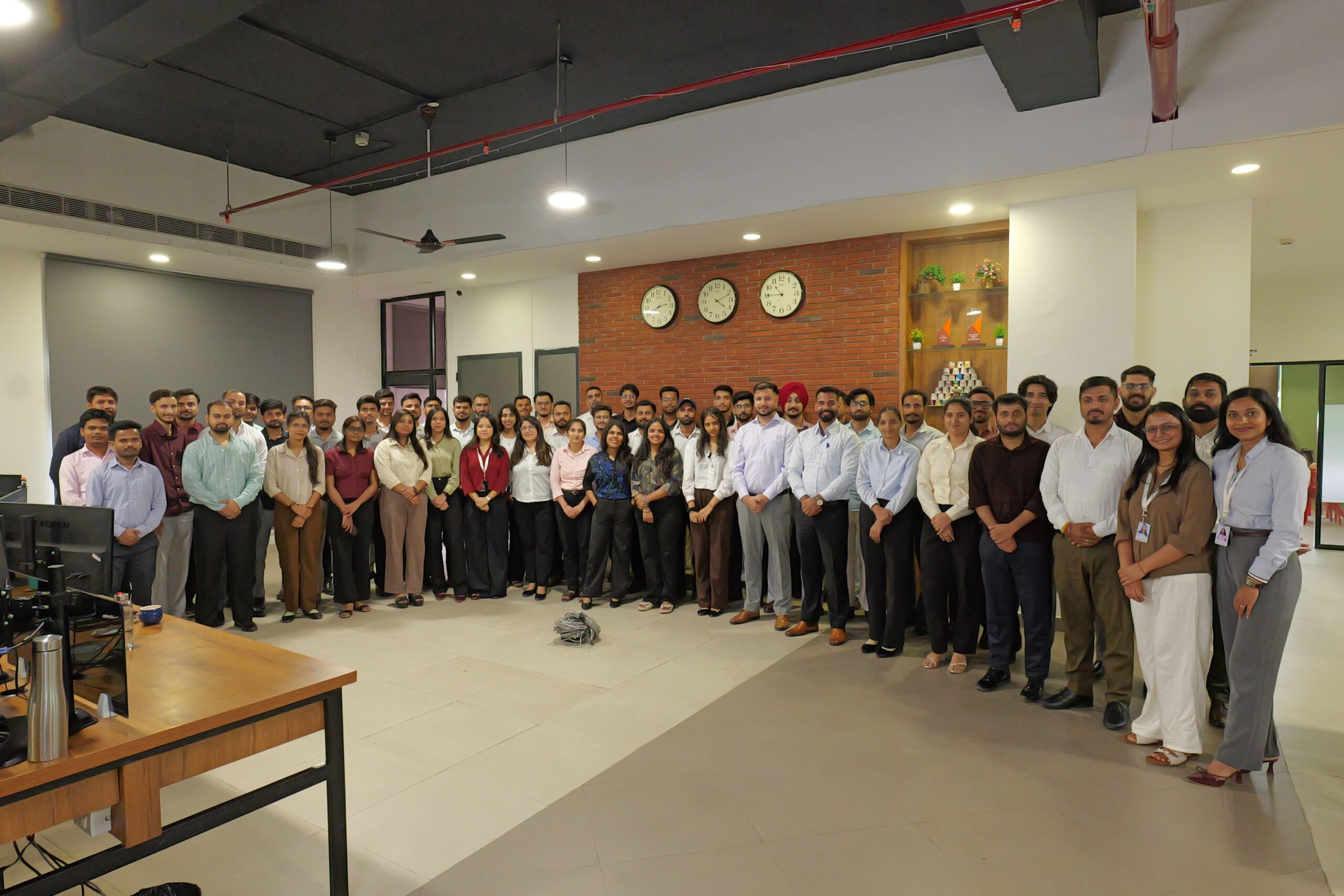
Why Global Businesses Choose LnP Infotech for Software Development in India
At LnP Infotech, we are one of India’s specialist software development firms founded in Mohali in 2018, with deep expertise across PropTech, healthcare software, finance software, .NET enterprise development, and legacy modernization.
We combine senior engineering talent with an AI-accelerated delivery model that gets clients to a working, production-ready product in weeks rather than months. Our work is not limited to writing code we understand the domain problems our clients are solving, which is why businesses across the US, UK, and beyond continue to trust us with mission-critical builds.
Our live proof: Bizukti and BillKaroPOS production SaaS products where every layer, from branding and UI design to API code, database, and test cases, was built by AI under our engineering direction.
Here’s what you get when you work with LnP Infotech:
- ✅ Senior-led engineering on every project no bait-and-switch to junior teams
- ✅ AI-accelerated delivery faster timelines without cutting corners on quality
- ✅ Deep domain expertise across PropTech, healthcare, finance, and enterprise software
- ✅ Full IP ownership your code, your data, your infrastructure on delivery
- ✅ Transparent scoping detailed breakdown of features, phases, and cost upfront
- ✅ Ongoing support we don’t disappear after go-live
India has the talent. The question is which partner puts it to work best for your project.
👉 Get a Free Consultation with LnP Infotech No commitment, just clarity.
Also explore our guides on Top 15 Software Development Companies in India 2026, and The ROI of AI-Accelerated Development.