
Everyone has the idea in some form a note on their phone, a sketch on a napkin, a rant to a friend that starts with “you know what would actually solve this?” The idea part is never the hard part. What’s hard is everything between “wouldn’t it be great if” and someone actually using the thing on their phone or laptop.
That gap is where most ideas quietly die. Not because they were bad ideas plenty of good ones stall out simply because nobody had a clear next step after “we should build this.” Here’s what that path from idea to working product actually looks like, and where it usually goes wrong.
What Actually Counts as “a Rough Idea” in Software Terms?
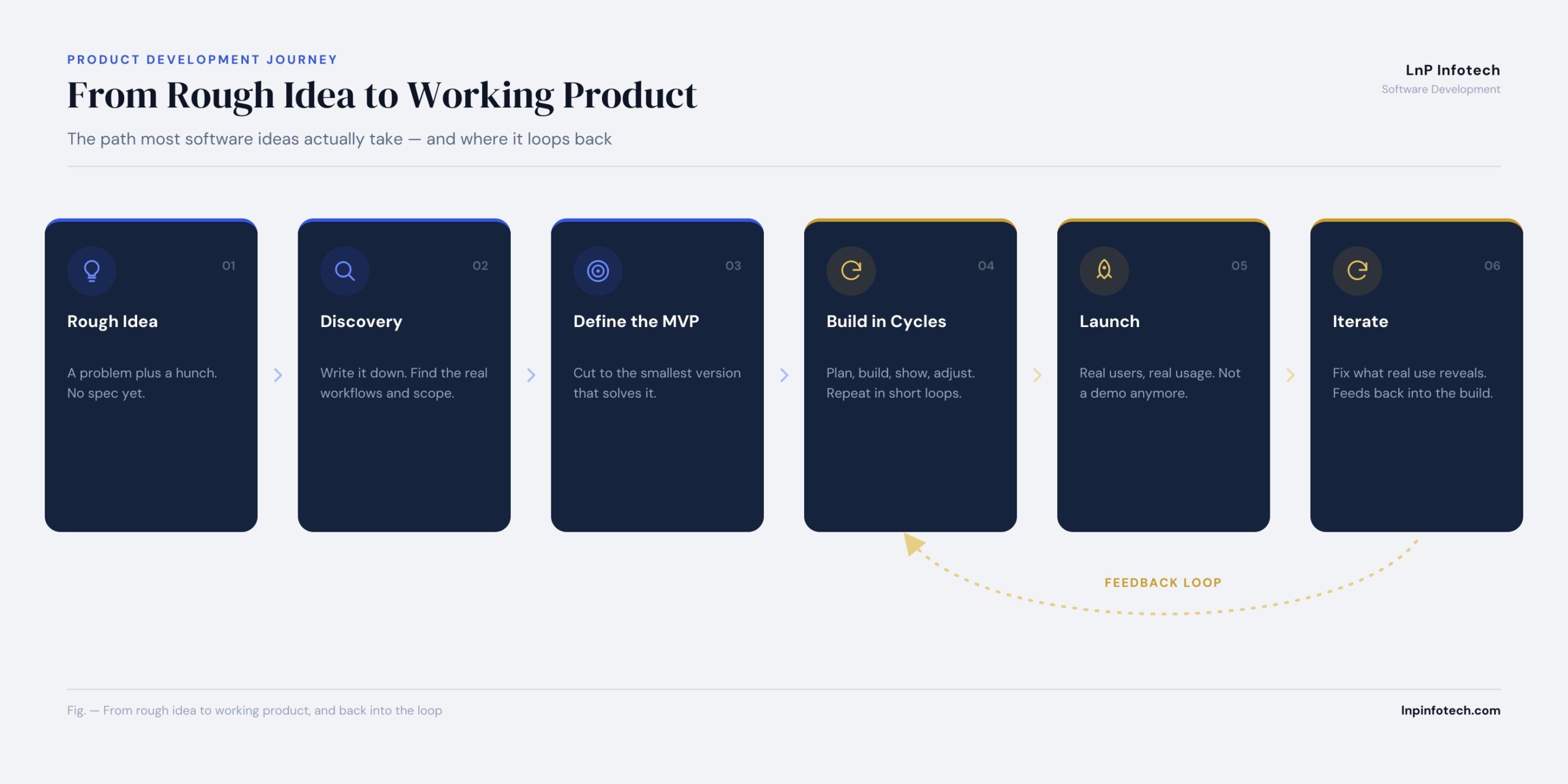
At this stage, an idea is usually a problem plus a hunch about the fix. “Our team wastes an hour a day chasing approvals over email” is a rough idea. So is “there’s no good way for tenants to pay rent and check their lease status in one place.” Neither of those is a spec. Neither has a tech stack, a screen layout, or a name yet. That’s fine that’s exactly what a rough idea is supposed to look like at this point.
The mistake people make here isn’t having too little detail. It’s assuming the idea has to be fully formed before it’s worth talking to anyone about. It doesn’t. The next step isn’t polishing it alone in a room it’s getting it in front of someone who’ll ask the annoying questions you haven’t thought of yet.
How Do You Turn That Idea Into Something You Can Actually Test?
Before a single line of code gets written, the idea needs to survive a bit of contact with reality. That usually means writing down, in plain language, who has this problem, how they deal with it today, and what would actually change if the software existed. Not a full requirements document just enough that two people reading it would picture the same thing.
This is also where you find out fast whether the idea is actually one idea, or five ideas wearing a trenchcoat. “A platform for landlords to manage everything” sounds reasonable right up until someone asks whether “everything” means rent collection, maintenance requests, lease documents, tenant screening, or all four at which point it’s suddenly four separate products, and you need to pick a starting point.
What Is Discovery, and Why Does Skipping It Cost You Later?
Discovery is the unglamorous part where a development team sits down with you and works out what’s actually being built before anyone starts building it the core workflows, who the users are, what data the system needs to hold onto, and which parts are genuinely hard versus which just look hard.
It’s tempting to skip this and go straight to building, especially when the idea feels obvious in your head. But “obvious in your head” and “buildable” aren’t the same thing, and the cost of catching a wrong assumption in a discovery conversation is an afternoon. The cost of catching it three months into development is a rebuild. Skipping discovery only really works for repeatable projects with a well-understood, unchanging set of requirements for anything new, teams that skip it don’t actually build faster, they just move the delay to later, when it’s a lot more expensive to fix.
Do You Need an MVP, or Can You Go Straight to the Full Product?
Almost always, start smaller than you want to. An MVP a minimum viable product isn’t a cheap, ugly version of the real thing. It’s the smallest version that still lets real users do the real task, so you find out if the idea holds up before you’ve spent the full budget on it.
The instinct to build everything at once usually comes from a good place you can see the whole vision, so why not build the whole vision? But the whole vision is also the version most likely to be wrong in ways you can’t predict from a whiteboard. An MVP gets something real in front of real users fast enough that you’re course-correcting with actual feedback instead of guesses.
There are exceptions. If you’re replacing an existing system for a known set of users with a fixed, well-understood workflow, going straight to a fuller build can make sense there’s less genuine uncertainty about what “done” looks like. But for a new idea nobody’s used yet, smaller and faster to test almost always beats bigger and slower to prove.
How Do You Decide What Goes Into the First Version?
This is where a lot of ideas get bloated before they even start. The honest question to ask is what’s the smallest thing that solves the actual problem not the smallest thing that impresses people in a demo. Those are often two different lists.
A useful way to sort this out is separating “needed to solve the core problem” from “would be nice, and we’ll add it once we know this works.” Login screens, admin dashboards, fancy reporting, multi-language support all of these matter eventually, and almost none of them matter for finding out if the core idea works. Cut ruthlessly here. You can always add features to something that works. It’s much harder to fix something that shipped everything and works for nothing.
What Does the Build Process Actually Look Like Once You Start?
Once scope is set, the work usually moves in short, repeatable cycles plan a chunk, build it, show it, adjust, repeat rather than disappearing for six months and reappearing with a finished product. That’s partly a technical choice and partly a trust one: you want to see the thing taking shape early enough to catch problems while they’re still cheap to fix.
Along the way, there’s a lot of unglamorous but necessary work happening underneath what you actually see setting up the database properly, deciding how the system will handle more users later, writing tests so nobody’s afraid to touch the code six months from now. None of that shows up in a demo. Skipping it is exactly how technical debt quietly turns a promising product into something nobody wants to touch a year in.
How Do You Know If What’s Being Built Actually Matches the Idea?
Mostly by looking at it regularly, not by waiting for a big reveal at the end. Short, frequent check-ins a working screen you can click through, not just a slide describing it catch drift early. If something feels off, it’s a lot cheaper to say so when it’s one screen than when it’s the whole app.
It also helps to keep coming back to the original problem statement. It’s easy for a project to slowly drift in scope from “solve this specific problem” toward “build every feature anyone suggested along the way.” Neither the team nor the client is wrong to suggest additions but somebody needs to keep asking whether a given feature is actually necessary, or just felt like a good idea in a meeting.
What Happens Once You Have a Working Product?
Launch isn’t the finish line, even though it feels like it should be. Real usage surfaces things no amount of planning does the screen nobody uses, the workflow that confused three people in the first week, the edge case nobody thought to mention. The work after launch is less about adding new things and more about paying attention to what real use reveals, then fixing the right things quickly.
This is also where a lot of the original “nice to have later” list finally gets revisited now backed by actual usage instead of guesses about what people might want.
What Should You Ask a Development Partner Before You Start?
A few questions tend to separate a good fit from a bad one early on:
- How do they handle discovery a real conversation about the problem, or just a form to fill out?
- What do they consider a reasonable first version, and will they push back if you try to cram too much into it?
- How often will you actually see progress, and in what form a working screen, or just a status update?
- What happens after launch is there a plan for support, or does the relationship end the day it ships?
The answers matter more than the sales pitch. A partner who asks hard questions about your idea before agreeing to build it is a better sign than one who says yes to everything.
Ready to Build the Right Custom Software for Your Business?
The distance between a rough idea and a working product isn’t really about talent or budget, though both help. It’s about not skipping the boring parts writing the idea down clearly enough that two people picture the same thing, cutting the first version down further than feels comfortable, and staying close enough to the build that drift gets caught early instead of late.
Ideas are cheap, and everyone has them. What’s rare is the discipline to turn one into something small, real, and working and then the patience to build outward from there instead of trying to build the whole vision on day one.
If you’ve got an idea you’re trying to shape into something real, we’re happy to talk through what a first version could look like no obligation, just a real conversation about the problem you’re solving.