
Choosing the right software is one of the most consequential decisions a real estate business can make. Get it right, and your team moves faster, closes more deals, and scales without friction. Get it wrong, and you’re locked into a platform that constrains your growth — paying for features you never use while manually workarounds the ones you actually need.
In 2026, the real estate software market is booming. The global market is estimated at $15.60 billion and is projected to reach $39.49 billion by 2033, growing at a CAGR of 14.2%. With so much investment flooding the space, you have more options than ever — but that also means the decision is harder than ever.
This guide breaks down the real differences between custom real estate software and off-the-shelf real estate software, compares the true total cost of ownership, and gives you a clear framework to make the right call for your business.
What Is Off-the-Shelf Real Estate Software?
Off-the-shelf software (also called COTS — Commercial Off-the-Shelf) is a pre-built solution designed for a broad range of users. You pay a subscription, configure a few settings, and you’re up and running.
Popular examples in real estate include:
- AppFolio — Property management for residential portfolios (50+ unit minimum)
- Buildium — All-in-one platform for small to mid-sized property managers
- Yardi Voyager — Enterprise-grade property and asset management
- HubSpot / Salesforce — CRM platforms with real estate adaptations
- Zillow Premier Agent — Lead generation and agent tools
These platforms have been battle-tested by thousands of businesses. They offer quick onboarding, regular updates, and built-in support. For many companies, especially those in the early stages, they’re an excellent starting point.
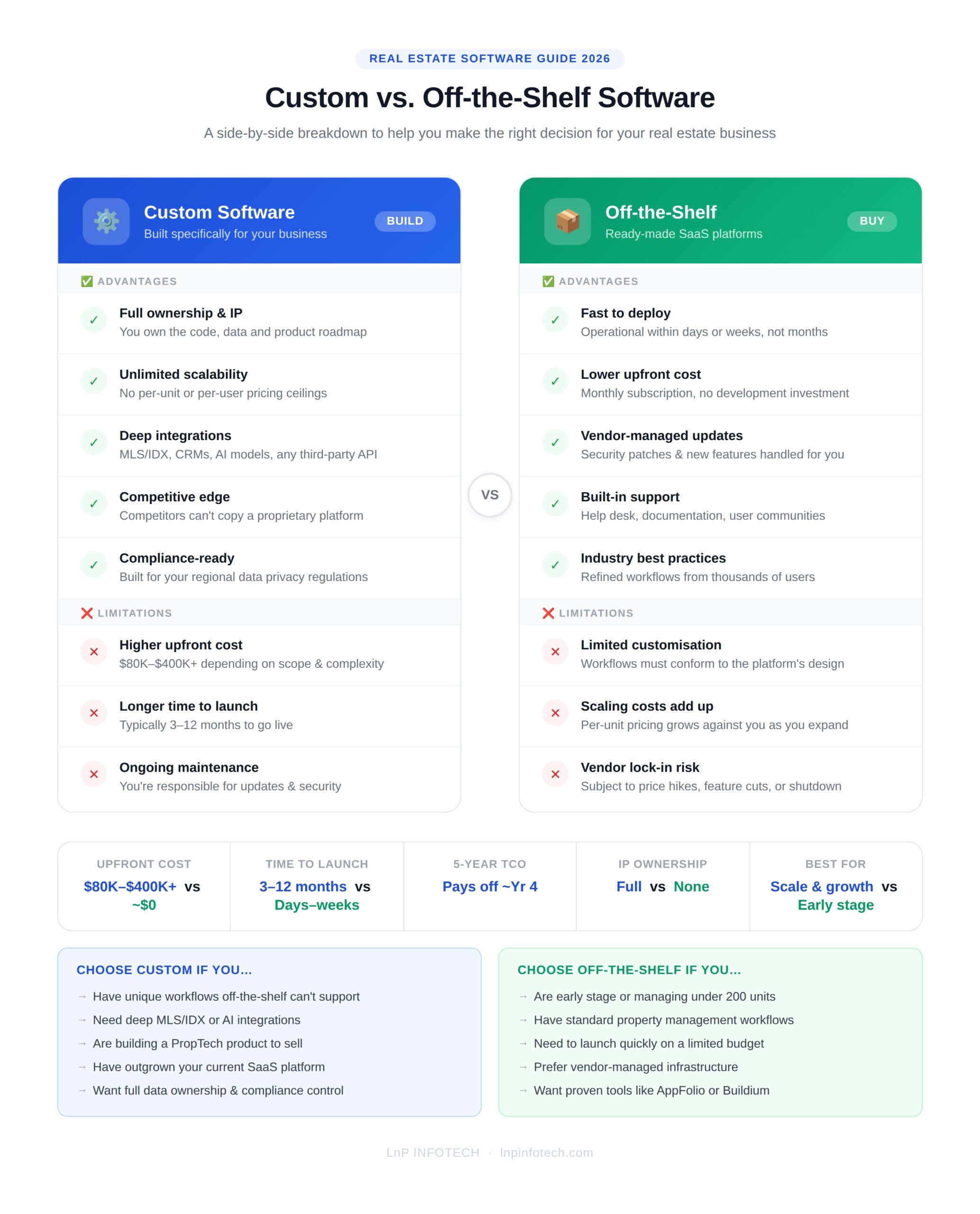
Pros of Off-the-Shelf Software
- Fast to deploy — You can be operational within days or weeks, not months
- Lower upfront cost — No development investment; just a monthly subscription
- Vendor-managed updates — Security patches, new features, and bug fixes handled for you
- Industry best practices baked in — Vendors have spent years refining workflows
- Built-in support teams — Help desks, documentation, and user communities
Cons of Off-the-Shelf Software
- Limited customization — Workflows must conform to the platform’s design, not yours
- Unused features — You often pay for functionality your team will never touch
- Integration friction — Connecting to your existing CRM, MLS, or marketing stack can be costly or impossible
- Vendor dependency — Pricing changes, feature cuts, or vendor shutdown are outside your control
- Scaling costs — Per-unit or per-user pricing models become expensive as you grow
Real-world reviews reflect this. Buildium users frequently criticize its reporting limitations and lack of customization. AppFolio users report payment management issues and limited flexibility for commercial or mixed portfolios. These aren’t deal-breakers for everyone — but they signal a real ceiling that growing businesses will eventually hit.
What Is Custom Real Estate Software?
Custom software is built specifically for your business — your workflows, your data models, your integrations, your users. A development team (in-house or external) designs and builds the platform from the ground up based on your exact requirements.
Common custom real estate builds include:
- Bespoke property management systems (PMS)
- Custom CRM platforms built for specific brokerage workflows
- Investor portals for real estate funds and syndicates
- MLS/IDX-integrated property listing platforms
- AI-powered lead scoring and nurturing tools
- Fractional ownership and commercial lease management platforms
Pros of Custom Software
- Built around your workflows — No compromises, no workarounds, no “close enough”
- Full IP ownership — You own the code, the data, and the product roadmap
- Competitive differentiation — Your competitors cannot replicate a platform proprietary to you
- Deep integrations — Native connections to MLS/IDX, your CRM, third-party APIs, and data providers
- Unlimited scalability — Grows exactly as fast as your business without per-unit fees
- Compliance-ready — Built to your jurisdiction’s data privacy and regulatory requirements
Cons of Custom Software
- Higher upfront investment — Development cost is the biggest barrier for most teams
- Longer time to market — Expect months, not days, before going live
- Requires ongoing maintenance — You’re responsible for updates, security, and technical debt
- Team dependency — You need developers or a long-term tech partner to maintain and evolve it
- Risk of scope creep — Without disciplined project management, budgets can balloon
Cost Comparison: The Real Numbers
This is where most comparisons go wrong. People look at the upfront cost and assume off-the-shelf is cheaper. Over time, that’s rarely true.
Off-the-Shelf: The Hidden Costs
| Cost Type | Details |
|---|---|
| Monthly subscription | $300–$3,000+/month depending on platform and units |
| Per-unit fees | $1–$3 per unit/month (AppFolio: $1.49/unit, 50-unit minimum = $298/month floor) |
| Premium integrations | Many platforms charge extra for API access or third-party connectors |
| Onboarding fees | Buildium charges separately for onboarding; AppFolio gates support by tier |
| Staff time workarounds | Manual data re-entry, spreadsheet exports, shadow IT — the “workaround tax” |
| Lock-in switching costs | Migrating data and retraining teams when you eventually outgrow the platform |
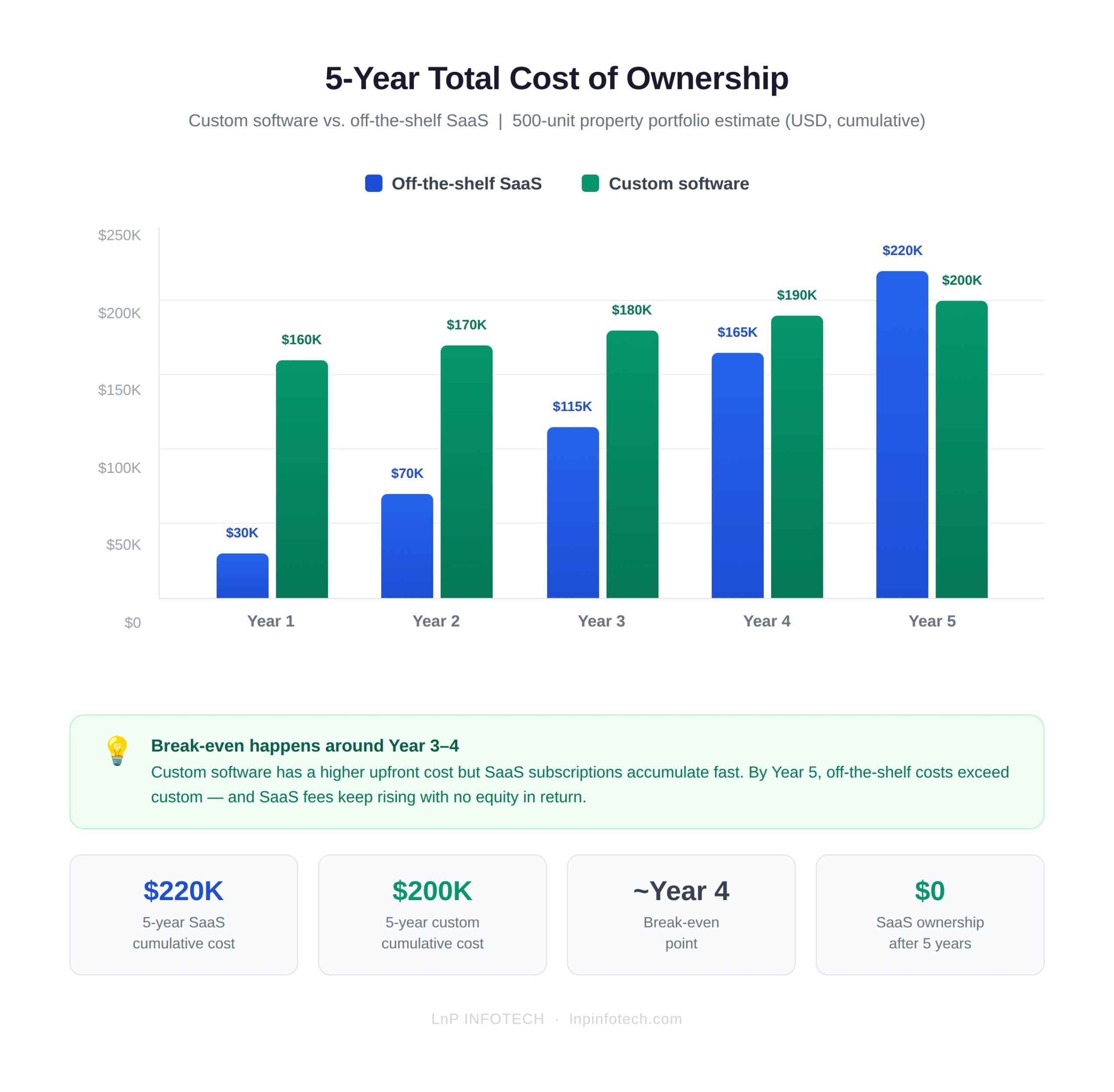
Over five years, a mid-sized property management firm managing 500 units could easily spend $150,000–$250,000 in SaaS fees alone — without owning anything at the end.
Custom Software: What to Expect?
| Platform Type | Estimated Development Cost |
|---|---|
| Basic property listing portal | $30,000–$60,000 |
| Property management system (PMS) | $80,000–$150,000 |
| Full-featured PropTech platform with AI | $150,000–$400,000+ |
| Enterprise-grade multi-market system | $300,000–$700,000+ |
The key insight: for businesses with a $150,000+ software budget and unique operational workflows, custom development typically pays for itself within 3–4 years — while giving you unlimited scalability and competitive advantage that no off-the-shelf platform can offer.
The “Workaround Tax”: The Hidden Cost Nobody Talks About
One of the most underrated arguments for custom software is what it costs you not to build it.
If your team is:
- Exporting data from your PMS into Excel to run reports
- Manually re-entering leads from your website into your CRM
- Using three different platforms that don’t talk to each other
- Paying staff to do tasks that should be automated
…then you’re already paying for a custom build. You’re just paying for it in staff time, errors, and missed opportunities rather than development dollars.
In 2026, where agentic AI and automation work best on clean, connected data, a fragmented tech stack doesn’t just slow you down — it actively prevents you from unlocking the competitive advantages your industry is moving toward.
When to Choose Off-the-Shelf?
Off-the-shelf software is the right choice when:
You’re early stage. If you’re managing fewer than 200 units or running a small brokerage, platforms like Buildium or AppFolio give you professional-grade tools without enterprise-level complexity or cost.
Your workflows are standard. If your operations look like what most property managers do — rent collection, lease tracking, maintenance coordination, tenant communications — you don’t need to reinvent those workflows from scratch.
Speed to market is critical. Launching a new service or entering a new market? Off-the-shelf gets you operational in days.
You want vendor-managed infrastructure. Security, uptime, and updates are handled for you. This matters if you don’t have an internal tech team.
Budget is limited. The upfront investment in custom development isn’t feasible for every business at every stage. Start with off-the-shelf, build revenue, then invest in custom when the ROI is clear.
When to Choose Custom Software?
Custom software is the right investment when:
Your workflows are unique. Multi-market brokerage operations, fractional ownership, commercial lease management, or investor portals — these are use cases that off-the-shelf platforms simply weren’t built for.
You’ve hit the ceiling. You’re spending more time working around your software than working with it. Workarounds are a tax on your growth.
Integration is mission-critical. You need deep, native connections to MLS/IDX, proprietary CRM logic, AI tools, or specialized data providers — not middleware hacks.
You’re building a PropTech product. If you plan to sell or license your platform to other businesses, you need to own the code.
Compliance demands it. Regional data privacy laws, state licensing requirements, or fair housing compliance (like CCPA in California) may require specific data handling, audit trails, or security architecture that generic platforms can’t provide.
Long-term SaaS costs are adding up. If your current subscriptions are trending toward $100,000+ per year, the math on custom development starts to look very different.
The Hybrid Approach: The Best of Both Worlds
Here’s a decision many businesses overlook: you don’t have to choose one or the other.
Many successful real estate businesses use a hybrid model — off-the-shelf for standard, commoditized functions, and custom software for the workflows that actually drive revenue or competitive advantage.
Examples of a hybrid approach:
- Use QuickBooks for accounting + custom investor portal for LnP reporting
- Use HubSpot for marketing emails + custom lead scoring engine built on your proprietary data
- Use Buildium for basic property management + custom analytics dashboard for executive reporting
- Use AppFolio for residential operations + custom commercial lease management module
This approach works because not every system needs to be built from scratch. Identify your commoditized workflows (where off-the-shelf excels) vs. your revenue-critical or differentiated workflows (where custom wins) — and deploy accordingly.
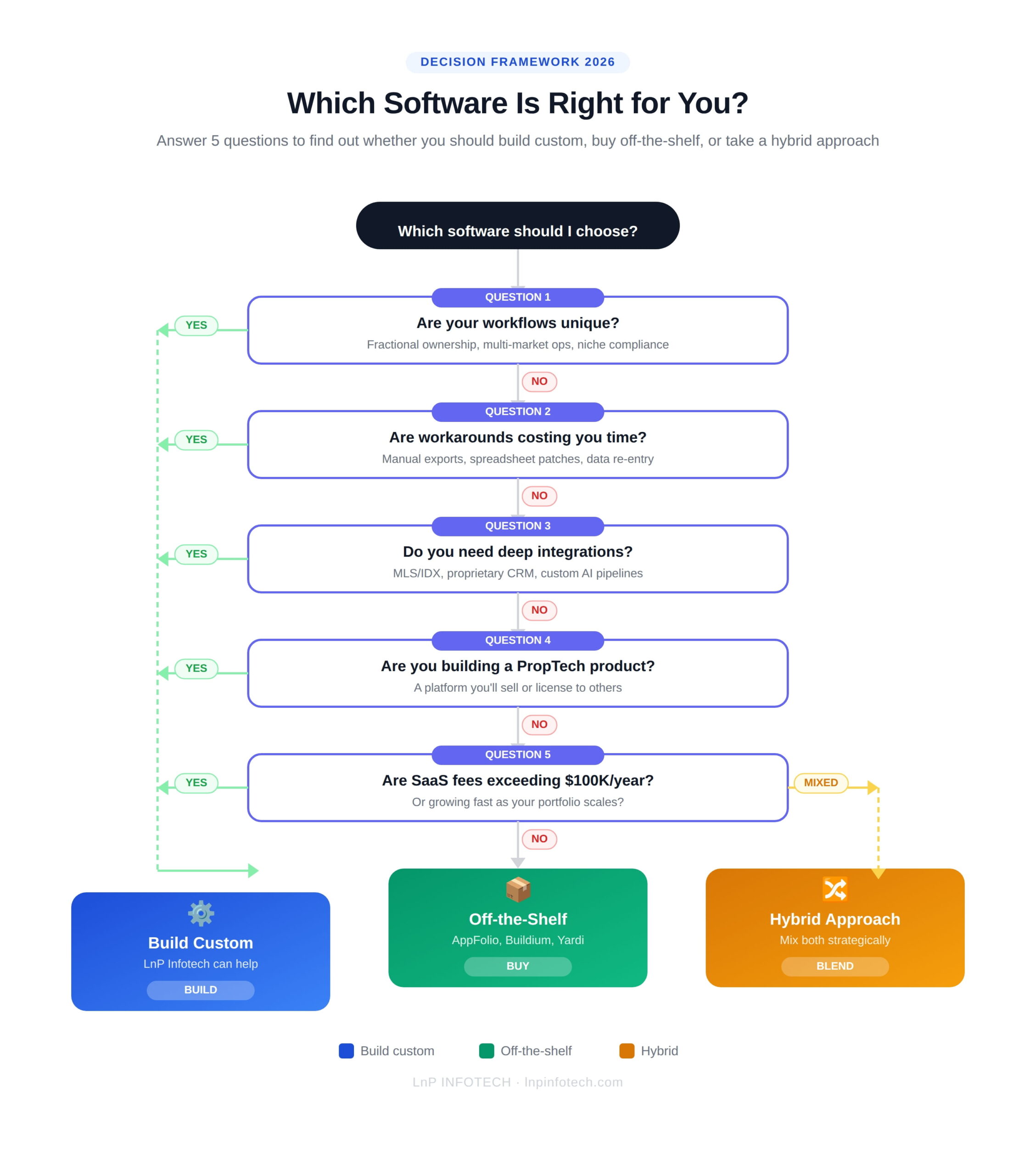
A 5-Question Framework to Make Your Decision
Use this checklist to cut through the noise and make a confident call:
1. How unique are your workflows? If your operations look like most real estate businesses, off-the-shelf will serve you well. If they’re genuinely different — fractional ownership, multi-market operations, niche compliance requirements — custom is likely the answer.
2. How much are you spending on workarounds? Count the hours your team spends manually moving data, running reports outside the system, or using spreadsheets to fill gaps. If that number is significant, you may already be paying for custom development without getting it.
3. What does your 3-year growth plan look like? If you’re planning to double or triple your portfolio, per-unit SaaS pricing will scale against you. Custom software scales with you at a fixed cost.
4. Do you need deep integrations? If your competitive advantage depends on connecting proprietary data sources, custom AI models, or niche APIs that off-the-shelf platforms don’t support, custom is the only path.
5. Do you plan to build a product to sell? If your software is the product — a PropTech platform you’ll sell or license — custom development is non-negotiable. You can’t build IP on someone else’s infrastructure.
Scoring:
- 4–5 answers point to custom → Invest in custom development
- 2–3 mixed answers → Explore a hybrid approach
- 0–1 answers point to custom → Start with off-the-shelf, revisit in 18–24 months
Real Estate Software Landscape: 2026 Market Snapshot
The real estate software market is no longer just about property management and listings. The fastest-growing categories in 2026 include:
- AI-powered predictive analytics — Property valuation, pricing trends, buyer behavior models
- Agentic AI for lead qualification — Automated tour scheduling, follow-up, and deal management
- Sustainability compliance tools — ESG reporting, energy efficiency ratings, green certifications
- Smart building integrations — IoT-connected property management for commercial real estate
- Vertical PropTech platforms — Niche solutions for eco-friendly homes, senior living, and remote-work-optimized properties
The commercial real estate segment alone is expected to capture 64% of the real estate software market in 2026, driven by complex operational requirements and the shift toward smart buildings and hybrid-work space optimization.
For businesses operating in any of these growth areas, generic off-the-shelf platforms increasingly struggle to keep pace. The more specialized your market, the stronger the case for custom.
Final Verdict
There’s no universal right answer — but there is a right answer for your business, at your stage, with your goals.
Choose off-the-shelf if you’re early stage, your workflows are standard, speed matters, and your budget is limited. Platforms like Buildium, AppFolio, and Yardi Voyager are genuinely excellent tools for what they’re designed to do.
Choose custom software if your workflows are unique, you’ve hit a growth ceiling, integrations are mission-critical, compliance demands it, or you’re building a PropTech product. The upfront investment is real, but so is the long-term payoff in scalability, competitive advantage, and IP ownership.
Choose hybrid if you have a mix of standard and differentiated needs. Use off-the-shelf where it works, and build custom where it counts.
Whatever you decide, make it deliberately — not by default. The wrong choice quietly taxes your team for years. The right one compounds your advantage every quarter.
Frequently Asked Questions
How long does it take to build custom real estate software? Depending on complexity, expect 3–9 months for a core platform. A basic property listing portal might take 3–4 months; a full-featured PMS with AI capabilities can take 6–12 months or more.
Can I migrate from off-the-shelf to custom later? Yes, and many businesses do. Start with off-the-shelf to validate your model, then invest in custom when your workflows, budget, and growth trajectory justify it. Just plan for data migration costs and a transition period.
What tech stack is typically used for custom real estate software? Common choices include React or Next.js for frontend, Node.js or Python for backend, PostgreSQL or MongoDB for data, and AWS or GCP for infrastructure. AI features often integrate OpenAI, Anthropic, or specialized PropTech AI APIs.
Is custom software secure? It can be — and often more so than SaaS platforms, because you control your own data architecture. However, security is your responsibility. This means regular audits, penetration testing, and keeping dependencies updated.
How do I find a real estate software development company? Look for partners with demonstrated PropTech experience, MLS/IDX integration knowledge, and a portfolio of real estate-specific builds. Platforms like Clutch and G2 list vetted firms with verified reviews.
Ready to Build the Right Real Estate Software for Your Business?
At LnP Infotech, we specialize in custom real estate software development — from property management systems and investor portals to AI-powered PropTech platforms built for scale.
Whether you’re outgrowing your current off-the-shelf tools, need deep MLS/IDX integrations, or are ready to build a proprietary platform that competitors can’t replicate, our team has the experience to deliver.
Here’s what you get when you work with LnP Infotech:
- ✅ Custom PropTech solutions tailored to your exact workflows
- ✅ End-to-end development — from discovery and design to launch and support
- ✅ Deep integrations with MLS/IDX, CRMs, payment gateways, and third-party APIs
- ✅ AI-ready architecture for predictive analytics, lead scoring, and automation
- ✅ Compliance-focused builds meeting regional data privacy and real estate regulations
- ✅ Transparent pricing with no hidden fees
Don’t let the wrong software hold your business back. Let’s talk about what the right custom solution could look like for you.
👉 Get a Free Consultation with LnP Infotech — No commitment, just clarity.