Published: September 2026 | Reading Time: 10 min | Category: Software Development
Let’s be honest about how most “top software companies” lists get written.
Someone searches a directory, grabs the names with the most reviews, adds a paragraph about each, and calls it a ranking. The result looks authoritative but tells you nothing useful about whether any of those companies would actually be right for what you’re trying to build.
This one is different. We deliberately left off the giants – TCS, Infosys, Wipro, HCL, Tech Mahindra. They’re excellent at what they do, but what they do is serve Fortune 500 enterprises with multi-million dollar budgets and multi-year timelines. If that describes your project, you already know their names and don’t need a blog post to find them.
This list is for everyone else. Startups that need to move fast. Mid-market businesses that want a partner who actually picks up the phone. Product companies that need domain expertise, not a ticket in a queue. The companies below are the ones worth knowing in 2026, what they’re genuinely good at, and who they’re built for.
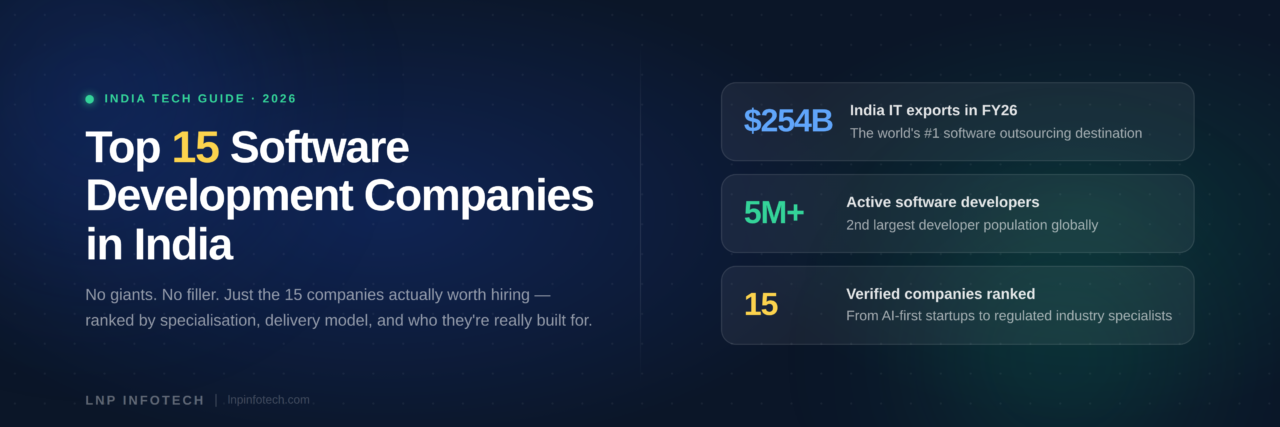
India has over 5 million active software developers, produces 1.5 million engineering graduates every year, and exported $254 billion in IT services in FY26. The talent is deep and the engineering maturity is real. The challenge is that the market is enormous and finding the right partner means knowing which companies are built for your type of project, not just which ones are biggest.
1. LnP Infotech
Headquarters: Mohali, India
Founded: 2018
Best for: Custom SaaS, PropTech, healthcare software, .NET enterprise, AI-accelerated delivery.
Website: lnpinfotech.com
If you need a working, production-ready product quickly not a ticket in a queue at a company managing 200 other clients, LnP Infotech is the name that keeps coming up.
Founded in 2018 in Mohali, LnP Infotech has built its reputation on a combination of deep domain expertise and an AI-accelerated delivery model that most firms are still figuring out. We use AI Codex and agentic development tools across the full build cycle planning, code generation, testing, documentation which means we can deliver in weeks what traditional teams take months to produce. Our live proof is Bizukti and BillKaroPOS production SaaS products where every layer branding, UI design, React frontend, API code, database, and test cases was built by AI under our engineering direction.
Domain expertise is where we really stand out. In PropTech, we build property management platforms, tenant portals, lease management systems, and MLS/IDX-integrated applications. In healthcare, we handle prior authorization workflow tools, patient intake systems, care coordination dashboards, and HIPAA-compliant platforms. In finance, we deliver loan origination interfaces, client onboarding portals, and investment reporting dashboards. And in enterprise software, we specialize in .NET microservices, legacy modernization, and custom internal tooling.
Your project matters to our leadership. You get senior engineers, direct communication, and a team that understands the problem they’re solving not just the technology stack they’re building on.
What we’re best at: Custom SaaS with AI-assisted delivery, PropTech, healthcare software, .NET enterprise, legacy modernization.
Ideal client size: Startups, scale-ups, and mid-market businesses.
Not the right fit for: Fortune 500 multi-year transformation programs requiring thousands of resources.
2. Persistent Systems
Headquarters: Pune, India
Founded: 1990
Best for: Software product engineering, ISV partnerships, cloud-native development.
Persistent Systems doesn’t get the press coverage the big four attract, but in product engineering circles it’s one of the most respected names in India. Revenue crossed $1.5 billion in FY26, making them one of the fastest-growing mid-tier IT companies in the country over the last three years.
Their focus on software product engineering helping product companies build faster and scale reliably gives them a differentiated position from the generalists. They work heavily with ISVs (independent software vendors) and technology companies that need an engineering partner who understands the full software product lifecycle, not just delivery sprints.
What Persistent does well is bringing senior-level thinking to product architecture decisions. If you’re a product company that needs to augment your engineering team with experienced developers who genuinely understand product thinking not just feature factories they’re worth a serious look.
What they’re best at: Software product engineering, ISV partnerships, cloud-native development, data engineering.
Ideal client size: Mid-market and enterprise product companies.
Not the right fit for: Domain-specific builds in PropTech or healthcare where vertical expertise matters more than general product engineering.
3. Mphasis
Headquarters: Bengaluru, India
Founded: 2000
Best for: BFSI software, core banking modernization, insurance technology.
Mphasis made a strategic call years ago that’s paying off now: instead of trying to be everything to everyone, they went deep on BFSI banking, financial services, and insurance and became genuinely excellent at it. Their work includes core banking modernization, insurance platform engineering, mortgage processing automation, and capital markets technology.
Their Hyper-Personalization practice and focus on AI-driven customer experience in financial services gives them a sharper proposition than the generalists for BFSI-specific projects. A team that has solved the same class of problem fifty times before is going to solve your version of it faster, with fewer surprises, than one doing it for the fifth time.
If your project lives in financial services and you want a partner with deep sector knowledge, Mphasis should be on your shortlist.
What they’re best at: BFSI software, core banking modernization, insurance platform engineering, mortgage automation.
Ideal client size: Mid-market to enterprise financial services.
Not the right fit for: Industries outside financial services their depth is their strength and their limitation.
4. Coforge
Headquarters: Noida, India
Founded: 1992
Best for: BFSI, travel & hospitality software, business process automation.
Coforge is a strong example of how picking your battles carefully produces better outcomes than trying to compete across every sector. They’ve concentrated on three verticals BFSI, travel & hospitality, and insurance and built genuine depth in each. Revenue reached $1.3 billion in FY26, and they’ve been one of the most consistent mid-tier performers for three consecutive years.
Their business process management (BPM) capability is particularly strong. If your project involves automating complex workflows inside a regulated industry claims processing, policy administration, loan origination, travel booking systems Coforge’s combination of domain knowledge and technical delivery is a serious proposition. They don’t try to be a general-purpose development company, and that discipline shows in the quality of what they build.
What they’re best at: BFSI, travel software, insurance technology, business process automation in regulated industries.
Ideal client size: Mid-market.
Not the right fit for: Startups or companies outside their three core verticals.
5. Appinventiv
Headquarters: Noida, India
Founded: 2015
Best for: Mobile app development, UI/UX-led digital products, startup to enterprise.
Appinventiv has earned a strong reputation for design-first product development the kind of work where the user experience is the product, not just a layer on top of it. They’ve worked with both Fortune 500 brands and funded startups, which gives them an unusual range for a company their size.
Their particular strength is in mobile-first products and digital platforms where UI quality directly drives retention. Healthcare apps, fintech consumer products, on-demand service platforms, Appinventiv is consistently well-reviewed in these categories. They have over 1,200 employees and have delivered more than 3,000 projects across 15+ countries.
For businesses building consumer-facing products where design and user experience are going to make or break adoption, Appinventiv is one of the stronger names to evaluate.
What they’re best at: Mobile app development, UI/UX-led product design, digital platforms, healthcare and fintech consumer apps.
Ideal client size: Startups and mid-market, with select enterprise work.
Not the right fit for: Backend-heavy enterprise systems or projects where UX is not the primary driver of value.
6. ValueCoders
Headquarters: Gurugram, India
Founded: 2004
Best for: Dedicated developer teams, staff augmentation, multi-stack delivery.
ValueCoders has built its business around one thing: being the most reliable place to hire dedicated Indian developers for ongoing product work. With 650+ developers across stacks and nearly two decades of delivery experience, they’ve become one of the most recognized names in the staff augmentation segment.
Their hourly rates are transparent ($15–$35 depending on seniority and stack), their vetting process is documented, and their review counts on Clutch and GoodFirms are among the highest in their category 4,500+ projects delivered is not a made-up number. If your search started with “hire React developer India” or “hire .NET developer India,” you’ve probably already been on their site.
Where ValueCoders fits best is when you have a product that’s already defined and managed internally, and you need to extend your engineering capacity with reliable, experienced developers who slot into your existing workflows without a lot of onboarding overhead.
What they’re best at: Staff augmentation, dedicated developer teams, multi-stack delivery across React, Node, .NET, Python.
Ideal client size: Startups and SMBs with internal product management.
Not the right fit for: Projects that need end-to-end product ownership, strategic input, or deep domain expertise baked in.
7. Bacancy Technology
Headquarters: Ahmedabad, India
Founded: 2011
Best for: Agile development, JavaScript-heavy full-stack builds, cloud-native products.
Bacancy is an Agile-first firm with 1,000+ engineers and a particularly strong bench in modern JavaScript React, Next.js, Node alongside Golang and cloud-native development. Their developer quality on contemporary stacks is consistently praised in client reviews, and they’ve built a solid reputation in the US and UK markets for delivering senior-level engineering talent at Indian rates.
Their model sits between pure staff augmentation (ValueCoders) and full product ownership (LnP, Appinventiv). They’re excellent at plugging experienced engineers into an existing team or taking on a defined technical workstream within a larger project. Their design capability is thinner than some design-led firms, so they work best when the design thinking is already done and you need strong technical execution.
What they’re best at: Agile delivery, React/Next.js/Node development, Golang, cloud-native architecture.
Ideal client size: Startups and mid-market, particularly US and UK clients.
Not the right fit for: Projects that need end-to-end product strategy, design thinking, or deep domain specialization.
8. Simform
Headquarters: Ahmedabad, India
Founded: 2010
Best for: Cloud consulting, DevOps, full-stack product development, US/UK engagement.
Simform is one of the better-rounded mid-market options on this list strong in cloud consulting and DevOps, with a full-stack product development practice that spans web and mobile. They’re consistently well-rated on Clutch and have built a client base heavily weighted toward the US market, which shows in how they communicate and manage projects.
What Simform does particularly well is engagement quality. Consistent, proactive communication, clear project visibility, and a client-facing model that doesn’t require the client to chase updates these things get consistent praise in their reviews and matter enormously in any offshore engagement. For US and UK businesses evaluating their first Indian software development partner, Simform is one of the lower-risk starting points on this list.
What they’re best at: Cloud consulting, DevOps, full-stack product development, US/UK market engagement model.
Ideal client size: Startups and SMBs, particularly from US and UK.
Not the right fit for: Large enterprise programs or highly domain-specific builds requiring vertical expertise.
9. TatvaSoft
Headquarters: Ahmedabad, India
Founded: 2001
Best for: Custom software development, .NET and Java enterprise, healthcare and logistics.
TatvaSoft has been quietly building a strong reputation for over two decades long enough to have seen multiple technology cycles and developed genuinely mature delivery processes. Their strengths sit in custom enterprise software, with particular depth in .NET, Java, and the healthcare and logistics verticals.
They carry Microsoft Gold Partner and ISO 9001 certifications, and their client reviews consistently note disciplined project management and reliable delivery timelines. For businesses that want a partner with a long track record not a newer firm still finding its delivery rhythm TatvaSoft’s 23 years of operation is a meaningful signal.
What they’re best at: Custom enterprise software, .NET and Java development, healthcare software, logistics platforms.
Ideal client size: SMBs and mid-market.
Not the right fit for: Cutting-edge AI-first development or startups that need MVP speed above all.
10. Aalpha Information Systems
Headquarters: Mangaluru, India
Founded: 2008
Best for: Custom software, web and mobile development, international clients across 45+ countries.
Aalpha rounds out this list as one of India’s most globally distributed mid-market firms. They’ve completed 1,550+ projects for 1,850+ clients across more than 45 countries a breadth of international experience that’s uncommon for a company their size. They work with businesses ranging from early-stage startups to established enterprises across healthcare, education, real estate, and retail.
Their strength is reliability and international orientation. For businesses outside India that want a development partner with genuine experience navigating time zones, cultural communication differences, and international project expectations not a firm where international clients are the exception Aalpha’s track record is relevant.
What they’re best at: Custom software development, web and mobile apps, international client management across diverse industries.
Ideal client size: SMBs and mid-market globally.
Not the right fit for: Projects needing deep vertical specialization or AI-accelerated delivery speed.
11. Daffodil Software
Headquarters: Gurugram, India
Founded: 1999
Best for: Custom enterprise software, healthcare technology, supply chain, AI products.
Daffodil Software sits in an interesting middle ground too specialized to be a generalist, too large to be a boutique. With around 1,000 employees and clients that include Samsung, Denso, and Reckitt Benckiser, they’ve built genuine enterprise credibility while staying focused on custom application development rather than trying to compete with the big four on scale.
Their healthcare and regulated industry work is particularly strong. They’ve delivered HIPAA-compliant platforms, hospital management systems, and complex enterprise integrations for over two decades. They publish a CSAT score and Net Promoter Score they update annually a level of transparency about delivery quality that not many firms in their tier bother with.
If you’re in healthtech, supply chain, or building an AI-powered enterprise product and want a partner with regulated-industry sensibility and a track record with recognizable clients, Daffodil deserves a serious look.
What they’re best at: Custom enterprise software, healthcare technology, supply chain platforms, AI-integrated products.
Ideal client size: Mid-market and enterprise.
Not the right fit for: Startups that need fast MVP delivery or consumer-facing product design.
12. Net Solutions
Headquarters: Chandigarh, India
Founded: 2000
Best for: Digital product engineering, UX-led development, US/UK mid-market clients.
Chandigarh-based Net Solutions has been building digital products for over two decades and has worked with names that lend genuine credibility to their portfolio Microsoft, Harvard Business Review, and American Express appear in their public reference list. They position themselves around digital product engineering with a strong UX and design capability baked in.
What makes Net Solutions stand out is their balance of strategic product thinking and technical execution. They’re not just a development shop they bring user research, product strategy, and UX design into the engagement before a line of code is written. For businesses building products where the user experience is a competitive differentiator, that full-cycle capability is genuinely valuable.
Their international orientation is strong, with most of their client base in North America and the UK. Communication and project management standards are consistently well-reviewed.
What they’re best at: Digital product engineering, UX-led development, product strategy, web and mobile platforms.
Ideal client size: Mid-market, particularly US and UK.
Not the right fit for: Pure backend or enterprise system builds where UX is not the primary driver.
13. Kellton Tech
Headquarters: Hyderabad, India
Founded: 2009
Best for: Cloud, AI, IoT, digital transformation, enterprise-scale product engineering.
Kellton Tech is the most enterprise-leaning company in the second half of this list a 1,800+ person technology consultancy with deep capabilities in cloud computing, AI, IoT, and digital transformation. They serve both Fortune 500 companies and mid-market businesses globally, and their public positioning emphasises AI-driven consulting alongside product engineering.
Their particular strength is in complex, multi-system environments cloud adoption programs, data engineering at scale, integrated digital platforms for large distributed organizations. They’ve built a strong reputation in digital commerce and ERP/CRM implementations, and their engagement with MSA Safety (whose Software Dev Manager praised their rapid turnaround) reflects how they work with established enterprises going through technology change.
For mid-market businesses that are outgrowing their current technology infrastructure and need a partner who can think in systems not just deliver features Kellton is worth evaluating.
What they’re best at: Cloud solutions, AI and IoT integration, digital commerce, ERP and CRM, data engineering.
Ideal client size: Mid-market to large enterprise.
Not the right fit for: Startups or early-stage MVPs; their model suits established businesses with complex systems.
14. OpenXcell
Headquarters: Ahmedabad, India
Founded: 2009
Best for: Full-cycle custom software, AI/ML, mobile and web, affordable offshore delivery.
OpenXcell carries a CMMI Level 3 certification a process maturity standard that’s meaningful in the software development world and relatively rare at their price point. With 500+ engineers and rates starting at $20–$29/hour, they offer a combination of process discipline and cost efficiency that makes them one of the more interesting options for SMBs and startups that want structured delivery without enterprise pricing.
Their service breadth covers AI/ML, generative AI, blockchain, IoT, cloud, DevOps, mobile app development, and enterprise software. The breadth is a double-edged sword they can handle diverse projects, but they don’t have the deep vertical specialization of firms like Mphasis (BFSI) or LnP Infotech (PropTech, healthcare). Where they shine is full-cycle software delivery with good process rigour at an accessible price point.
What they’re best at: Custom software, AI/ML development, mobile apps, cloud, offshore delivery with CMMI Level 3 process discipline.
Ideal client size: Startups and SMBs.
Not the right fit for: Projects requiring deep domain expertise or complex integrations in regulated industries.
15. Radixweb
Headquarters: Ahmedabad, India
Founded: 2000
Best for: Custom software, legacy modernization, scalable enterprise platforms.
Radixweb has built a reputation over 24 years as a dependable custom software engineering company not flashy, not the most talked-about name in the market, but consistently well-reviewed for delivery quality and long-term product support. Their positioning is around scalable, secure, resilient software platforms and modernization work.
Their longevity is their strongest signal. Companies that have been in software development for two-plus decades and are still growing have figured out how to deliver reliably, retain clients, and adapt through technology cycles. Radixweb’s client retention track record reflects exactly that many of their clients have been with them for five or more years.
For businesses that want a stable, experienced partner for long-term product work rather than a one-time build, Radixweb’s engagement model is worth exploring.
What they’re best at: Custom software engineering, legacy modernization, long-term product maintenance, scalable platform development.
Ideal client size: SMBs and mid-market.
Not the right fit for: Fast-moving startup projects or cutting-edge AI-first development.

How to Use This List?
These fifteen companies are not interchangeable. They represent genuinely different strengths, delivery models, and client profiles. A few things worth being clear about:
- The giants are not on this list for a reason. TCS, Infosys, HCL, Wipro, and Tech Mahindra are excellent companies. They are also structurally built for large enterprise engagements. If your project is below $500,000 or needs to move in weeks rather than quarters, their model won’t fit your problem and you’ll get their least experienced teams anyway.
- Domain expertise beats general capability for specialized builds. A company that has built twenty prior authorization workflow tools will build your twenty-first faster, with fewer mistakes, and a clearer understanding of the edge cases. For general full-stack work, general capability is fine. For domain-specific products, vertical depth matters.
- Communication quality is more important than most buyers realize. Indian software engineering quality is well-established. What varies enormously is how well companies communicate, how visible progress is, and how responsive they are when something goes wrong. Ask every firm you’re evaluating specifically how they manage client communication. The answers tell you more than any portfolio.
- Ask about AI and expect a real answer. In 2026, software development companies not actively using AI across their build cycle are leaving speed and cost on the table. The best firms have integrated AI into planning, code generation, testing, and documentation. Ask specifically how and where. “We use Copilot” is not the same answer as a structured AI-augmented delivery model.
Quick Comparison
| # | Company | Best for | Client size | Specialization |
|---|---|---|---|---|
| 1 | LnP Infotech | Custom SaaS, PropTech, healthcare, .NET, legacy modernization | Startups to mid-market | AI-accelerated delivery, vertical depth |
| 2 | Persistent Systems | Product engineering, ISV | Mid-market | Software product lifecycle |
| 3 | Mphasis | BFSI, core banking | Mid-to-enterprise | Financial services |
| 4 | Coforge | BFSI, travel, insurance | Mid-market | BPM, regulated industries |
| 5 | Appinventiv | Mobile apps, UI/UX-led products | Startups to mid-market | Design-first development |
| 6 | ValueCoders | Staff augmentation, dedicated teams | Startups and SMBs | Multi-stack developer hiring |
| 7 | Bacancy Technology | Agile JS/cloud-native builds | Startups to mid-market | React, Node, Golang |
| 8 | Simform | Cloud, DevOps, full-stack | Startups and SMBs | US/UK engagement quality |
| 9 | TatvaSoft | Enterprise custom software | SMBs to mid-market | .NET, Java, healthcare |
| 10 | Aalpha Information Systems | Custom software, global clients | SMBs to mid-market | International reach, 45+ countries |
| 11 | Daffodil Software | Healthcare tech, enterprise, AI products | Mid-market to enterprise | Regulated industries, HIPAA |
| 12 | Net Solutions | Digital product engineering, UX-led | Mid-market | Product strategy + design + dev |
| 13 | Kellton Tech | Cloud, AI, IoT, digital transformation | Mid-market to enterprise | Complex multi-system environments |
| 14 | OpenXcell | Full-cycle custom software, AI/ML | Startups and SMBs | CMMI Level 3, affordable offshore |
| 15 | Radixweb | Custom software, legacy modernization | SMBs to mid-market | Long-term product support |
Frequently Asked Questions
Why aren’t TCS, Infosys, or Wipro on this list?
They’re deliberately excluded. Those companies are built for Fortune 500 enterprises with multi-million dollar budgets and multi-year timelines. They do excellent work for the right client. For startups, scale-ups, and mid-market businesses, their procurement cycles, minimum engagement sizes, and team structures make them a structural mismatch. This list is built specifically for companies that need a partner, not an enterprise vendor.
How much does it cost to hire a software development company in India?
Specialist and mid-tier firms typically range from $25–$60 per hour depending on seniority, stack, and engagement model. Staff augmentation firms like ValueCoders publish transparent rates from $15–$35/hour. AI-accelerated firms like LnP Infotech offer competitive rates with significantly faster delivery which reduces the effective cost-per-feature even when the hourly rate is comparable.
What should I look for when evaluating an Indian software development company?
Five things: domain expertise in your specific industry, case studies from comparable projects (not just logos), transparent communication processes, clarity on who will actually work on your project, and how they use AI in their development process. Run a small paid discovery or scoping exercise before committing to a full build it tells you more about a team than any sales conversation will.
Is it safe to outsource software development to India?
Yes, with standard due diligence. Check for a clear IP assignment clause in their contract, professional indemnity insurance, data security certifications (ISO 27001, SOC 2), and references from clients in similar industries. The established companies on this list have all navigated these questions many times.
How do I know if a company is genuinely AI-accelerated or just using AI as a marketing term?
Ask them to walk you through exactly where AI is used in their development process not in general terms, but specifically: which tools, at which stages, with what governance and review process. Ask for a recent example. A company that has genuinely integrated AI will answer this question in detail without hesitation. One that’s using AI as a positioning term will give you a vague answer about “leveraging AI capabilities.”
This article reflects independent research and editorial judgment. Company information is based on publicly available data as of September 2026.
Looking for a Software Development Partner in India?
At LnP Infotech, we’ve been building custom software for businesses across PropTech, healthcare, finance, and enterprise since 2018 using an AI-accelerated delivery model that gets clients to a working product in weeks, not months.
Whether you’re starting from scratch, modernizing a legacy system, or scaling a product that’s already live, we combine deep domain expertise with senior engineering oversight to deliver software that actually solves the problem not just software that ships.
Here’s what working with LnP Infotech looks like:
- ✅ Custom SaaS, PropTech, healthcare, finance, and enterprise software
- ✅ AI-accelerated development faster delivery without cutting corners
- ✅ Senior engineers on every project no bait-and-switch to junior teams
- ✅ Full IP ownership your code, your data, your infrastructure
- ✅ Transparent delivery fixed scopes, clear timelines, no surprises
- ✅ Ongoing support we don’t disappear after go-live
You’ve read the list. Now talk to the team that earned the top spot.
👉 Get a Free Consultation with LnP Infotech – No commitment, just clarity.
Also explore our guides on The ROI of AI-Accelerated Development, How We Build SaaS with AI Codex, and What Is Agentic AI to stay ahead of the curve.